
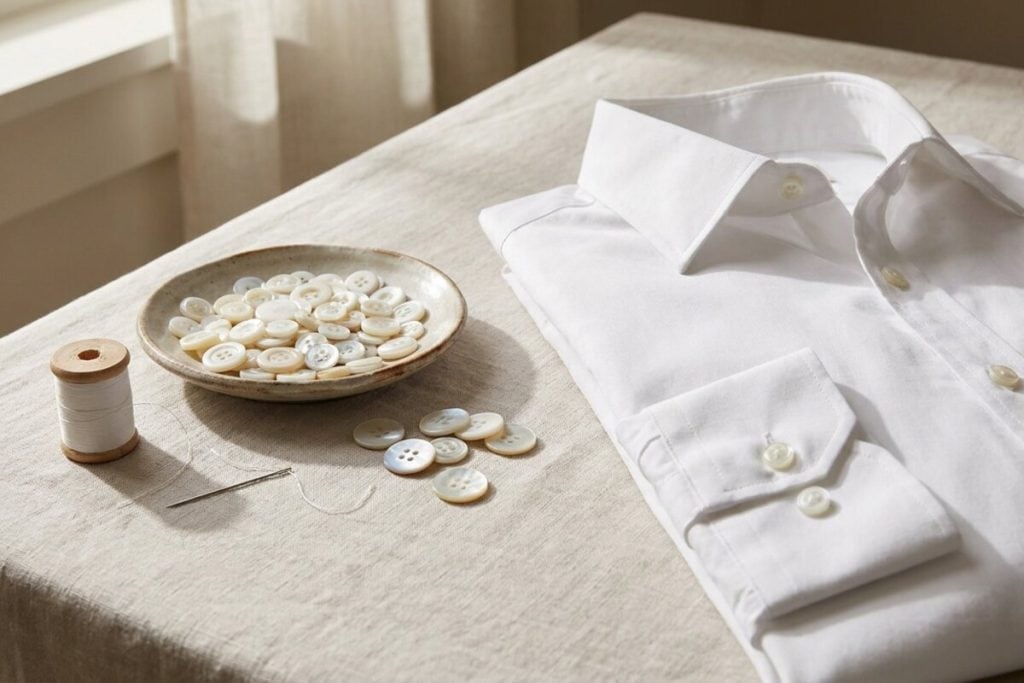
At a Glance
- Front placket buttons are 18L to 20L, which is 11.5mm to 13mm.
- Cuff and collar buttons go one size down, 14L to 18L.
- Dress shirts are almost always four hole. Casual and vintage shirts are often two hole.
- Mother of pearl looks better. Polyester survives a commercial laundry.
- A full set for one shirt is 12 to 16 buttons, so buy a pack of 20.
What Are Shirt Buttons?
Shirt buttons are flat sew through buttons, usually under 3mm thick. The thinness is the whole point. A coat button is 4mm or 5mm thick and sits on the fabric like a pebble, which is fine under a lapel. A shirt button has to pass under a tie, a seatbelt and a bag strap and lie flat again afterwards, so it is made shallow and the edges are rounded off.
They are also the only buttons on most garments that get washed every single time they are worn. That one fact drives almost every decision below. If you want the wider picture first, the complete button buying guide covers types, sizes and materials across all categories, and coat buttons sits at the opposite end of the thickness scale.
What Size Are Shirt Buttons?
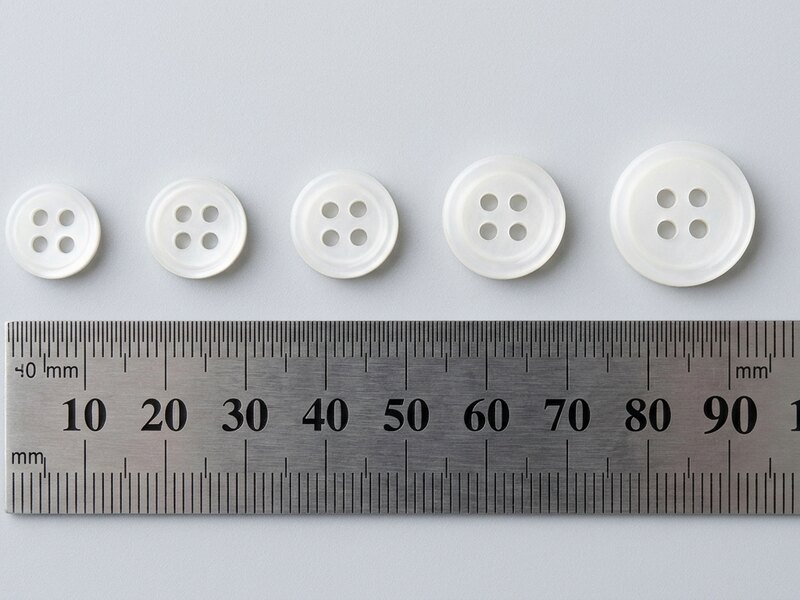
Shirt buttons are sold in ligne, written with an L. One ligne is 0.635mm, so 18L is 11.4mm and 20L is 12.7mm. Shirt makers stick to ligne because the increments are small enough to matter on a placket.
Front placket
18L to 20L. Use 18L on fine poplin and twill, where a bigger button starts to look like a coat fastening. Go to 20L on oxford cloth, chambray and flannel, because a thick weave swallows a small button and the placket looks under-built.
Cuffs
16L to 18L, one size down from the front. A barrel cuff has two or three buttonholes and a cuff button that matches the front exactly will catch on everything. Shirt makers have been sizing cuffs down for a hundred years for that reason.
Collar and sleeve placket
14L to 16L. These are the small ones: the hidden collar stand button, the button down collar points, and the gauntlet button halfway up the sleeve.
Most people measure the old button. Measure the buttonhole instead. A buttonhole is cut 2mm to 3mm longer than the button that is meant to go through it, so a 15mm hole wants a 12mm to 13mm button. The old button may have been the wrong size to begin with, which is often why it fell off. There is a full walkthrough in the button size guide, and the ligne explainer if the L numbers are new to you.
What Are Shirt Buttons Made Of?
Mother of pearl and shell
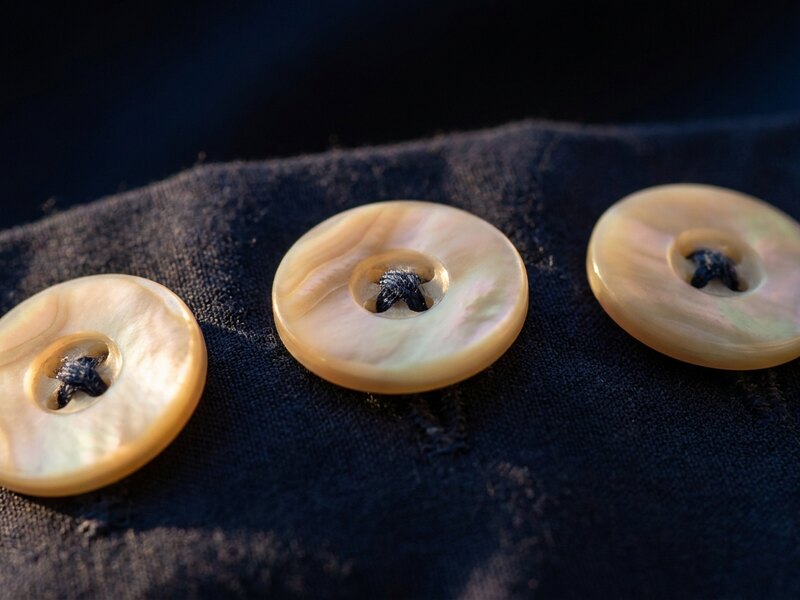
The traditional choice. Shell is cut from trochus or agoya and every blank has a different grain, so a row of them has a faint shift in colour down the placket. It feels cold for the first second you touch it, which is the easiest way to tell real shell from resin pretending to be shell. Expect to pay two to four times the price of polyester.
Here is the part most guides leave out. Shell is not automatically the right answer. It is brittle, and an industrial press at a commercial laundry will chip the rim or split the button outright, usually after a few months rather than a few years. If your shirts go out to a service every week, shell is a recurring cost, not an upgrade. Keep it for the shirts you wash at home at 30C. There is more detail on grades and finishes in the mother of pearl buttons guide, and our natural white shell buttons are the plain four hole version made for shirt fronts.
Polyester resin
The workhorse, and what the large majority of shirts actually use. It takes dye cleanly, so you can match an unusual shirt colour, and it holds up to 60C washes and a hot press without yellowing if the quality is decent. Cheap polyester does yellow, and it is one of the clearest tells of a low cost shirt. See the resin buttons guide for how the colours and finishes are produced, or the four hole patterned resin buttons if you want something with a bit of surface interest.
Metal and snaps
Uncommon on a shirt front except on western and work shirts, where metal snap buttons replace the sew through entirely. Metal on a dress shirt front reads as costume. The metal buttons guide covers the plating and finish differences if you are going that way deliberately.
Horn and wood
Fine on heavy flannel and overshirts, wrong on anything you would wear with a tie. Both are thicker than a shirt button should be, so check they clear the buttonhole before committing to a full set.
Two Hole or Four Hole?
Four hole for dress shirts, two hole for casual and most pre-1960s shirts. Vintage two hole buttons are the correct look if you are restoring an older shirt and the four hole version will read as a modern replacement.
Four holes are often sold as the stronger option. They are not, really. What keeps a shirt button on is the thread shank underneath, not the hole count. A two hole button sewn with three or four wraps of thread beneath it will outlast a four hole button stitched flat against the fabric. The extra holes mainly give you more stitch patterns and spread the load across a slightly wider area. The sew through versus shank comparison explains where each back type belongs.
How Many Shirt Buttons Do You Need?
Count before you order. A standard men’s dress shirt has seven buttons on the front placket, one hidden on the collar stand, two or three on each cuff, and one gauntlet button on each sleeve. That is 13 to 15 for a complete change. Women’s shirts often run eight or nine on the front because the placket starts higher.
Buy a pack of 20. Not because you need 20, but because shirt buttons are the single most frequently lost fastener in a wardrobe, and a shirt with one mismatched button is a shirt you stop wearing. Spares cost almost nothing now and are impossible to source in three years.
Why Replace Shirt Buttons?
- A low cost shirt with yellowed plastic buttons looks ten years older than it is. Swapping in shell for a few dollars is the cheapest upgrade in menswear.
- Commercial laundries crack buttons. Replacing a set is cheaper than replacing the shirt.
- One lost button on a hard to match colour retires an otherwise good shirt.
- Thrifted and vintage shirts are usually sound in the body and dead at the buttons. Our replacement buttons page covers how to match an existing set.
How Do You Stop a Shirt From Gaping?
The gap that opens between buttons across the chest is a buttonhole spacing problem, not a size problem, and no amount of changing the front buttons will fix it. The usual solution is a modesty button: a small flat button sewn between two existing ones, or a hidden fastener set behind the placket. Modesty buttons are made for exactly this. Fabric tape works too but comes off in the wash.
How Do You Sew On a Shirt Button?
- Thread a fine needle with a doubled polyester thread and knot the end.
- Come up through the fabric at the mark, then down through the first hole. On a four hole button, pick parallel bars or a cross and keep it consistent with the rest of the placket.
- Lay a toothpick or a pin across the top of the button and sew over it. This is what creates the slack for the shank.
- Make five or six passes, then pull the toothpick out.
- Bring the needle up between the button and the fabric and wrap the thread three times around the stitches, then push through to the back and knot off.
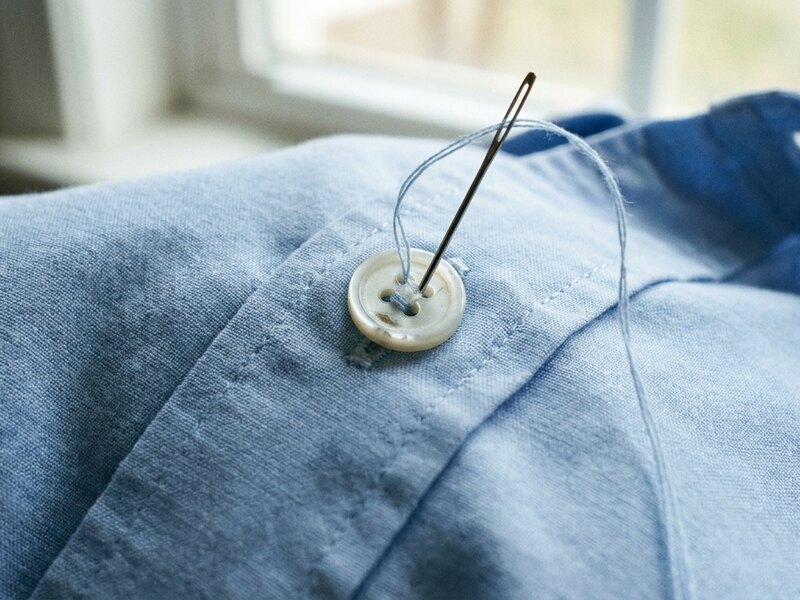
Match the thread to the fabric, not to the button. This is backwards from what most people do. The thread sits against the shirt for 11mm around the button, and a white thread on a blue shirt is far more visible than a white thread under a white button. Step by step photos are in how to sew on a button.
How Do You Care for Shirt Buttons?
- Button the collar and cuffs before washing. Open buttons catch on the drum and tear through the fabric.
- Shell and horn do not like 60C or a tumble dryer. Wash those shirts at 30C and hang them.
- If you iron with a hot press, work around the buttons rather than over them. A hot plate sitting on polyester will scorch it dull.
- Before the wash, run a thumb down the placket and tug each button. One that moves gets five minutes of sewing now instead of a lost button later.
Frequently Asked Questions
What size are standard shirt buttons?
18L to 20L on the front, which is 11.5mm to 13mm, and 14L to 18L on cuffs and collars.
Are shirt buttons all the same size on one shirt?
No. Fronts are largest, cuffs are one step down, collar and gauntlet buttons are smallest. Buying one size for the whole shirt is the most common mistake.
Can I put shell buttons on a cheap shirt?
Yes, and it is the single most effective thing you can do to a cheap shirt. Just do not send it to a commercial laundry afterwards.
How do I match a button colour I cannot find?
Take the closest white or cream you can get and change the whole set rather than one button. A full set in a slightly different white looks intentional. One odd button does not.
Do shirt buttons come with the holes pre-drilled at a standard spacing?
Hole spacing varies by maker. If you are machine sewing, check the spacing against your button foot before ordering a large quantity.
Rule of Thumb
18L on the front, 16L on the cuffs, four holes, and a pack of 20 so you still have spares in three years. Measure the buttonhole, not the old button.
Where to Buy Shirt Buttons
We stock plain and decorative shirt buttons in shell, resin and metal in the Shancco shop, including shell buttons in the sizes shirts actually use. If you want something less plain for a casual shirt, the decorative buttons guide is a good place to start.
Can You Buy Shirt Buttons Wholesale?
Yes. Shirt buttons are available for wholesale and bulk orders with trade pricing for shirt makers, uniform suppliers, tailors and repair studios. Minimums are low and we can match an existing colour from a sample. Get in touch for a wholesale quote.
Get in Touch
Send us the shirt details or a photo of the buttonhole and we will tell you the size you need. Contact Shancco.
Recommended Reading
- The Complete Button Buying Guide
- Button Size Guide
- Mother of Pearl Buttons
- Sew Through vs Shank Buttons
- How to Sew On a Button
- Replacement Buttons