
Quick answer: to find replacement buttons, measure the diameter of a button you still have in millimeters, count the holes or check whether it has a shank on the back, and note the thickness. Match those first and the color second. If no exact match exists, the usual fix is to move a button from the bottom of the garment into the visible gap and put the odd one where nobody looks.
A button comes off somewhere between the office and the car, and you notice at the worst possible moment. Or it survives the wash but comes out of the drum in two pieces. Either way you are now holding a coat that is otherwise perfectly good and completely unwearable, and the first thing most people do is search for one button that looks exactly like the one they lost.
That search usually fails. Not because the button does not exist, but because people search by appearance when they should be measuring first. Work in the other order: measure, check the back, then worry about how it looks.
At a Glance
- Measure first: Diameter in millimeters, straight across the face
- Then check: Shank on the back, or holes through the face
- Count the holes: Two or four, they are not interchangeable on every garment
- Check thickness: A thicker button will not pass through the same buttonhole
- Color comes last: It is the easiest thing to work around
- Buy spares: Two or three extra, not just the one you need
- No exact match? Move a hidden button to the visible spot
- Still stuck? Replace the whole set, or cover them
Where Is the Spare Button That Came With the Garment?
Before you buy anything, check the garment. Most shirts, coats and cardigans ship with a spare, and a surprising number of people never find it.
On a shirt, look at the inside of the front placket near the bottom hem, below the last buttonhole. It is often sewn flat against the fabric where you would never notice it. On a coat or jacket, check the inside of the lining near the side seam, or the inside of a pocket. On knitwear, it is usually in a small clear bag stitched to the care label.
If the garment came in a box or with a hang tag, the spare is sometimes in a tiny envelope attached to the tag. People throw those away without opening them.
Found one? You are done. Skip to how to sew it on.
How Do You Measure a Button for a Replacement?
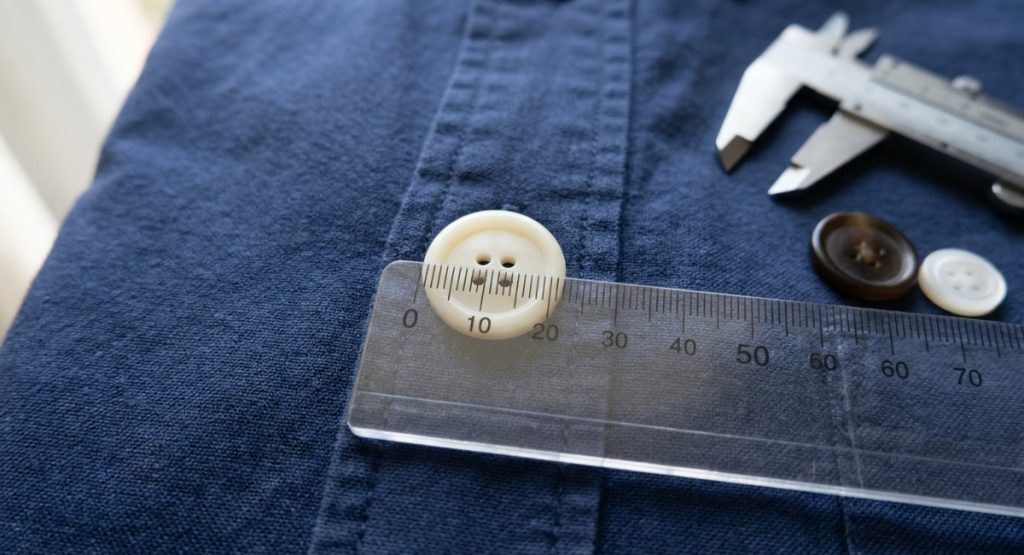
Take a button that is still on the garment and measure straight across the widest part of the face, in millimeters. Do not measure the shank, and do not include any raised rim or decorative edge that sits above the main body unless it is part of the outer diameter.
A ruler works. A pair of calipers works better. If you have neither, put the button on a piece of paper, trace around it, and measure the circle.
Almost every sizing problem we get asked about comes back to the same thing. The measurement was taken from a photo of the button someone wanted, not from the button sitting in their hand.
Typical sizes, so you know whether your measurement is plausible:
- Shirt front buttons: 10mm to 12mm
- Shirt cuff and sleeve buttons: 9mm to 11mm
- Cardigan and knitwear buttons: 15mm to 20mm
- Blazer front buttons: 20mm to 23mm
- Coat buttons: 23mm to 30mm
You will also see buttons listed in lignes, written as 24L or 32L. This is the traditional trade unit and it still turns up on packaging and wholesale listings. One ligne is 0.635mm, so 16L is roughly 10mm, 24L is roughly 15mm, 32L is roughly 20mm and 40L is roughly 25mm. If a listing gives you lignes and no millimeters, divide by 1.575 to get the approximate diameter.
Our button size guide has the full conversion table if you want to check a size before ordering.
What Do You Actually Need to Match?
Size and back type matter. Everything else is negotiable.
Diameter is the one that cannot be wrong. A button 2mm wider than the original will not pass through the buttonhole, and one that is 2mm narrower will slip open on its own all day. This is the single most common reason a replacement gets returned. While the ruler is out, measure the buttonhole too. The button has to be a little smaller than the hole is long, or it will not fasten at all.
Then look at the back, which matters just as much. A shank button has a loop or a stem behind it and sits raised off the fabric. A sew-through button has two or four holes and lies flat. Swapping one for the other changes how the garment closes, and on a thick coat a flat button will pull and pucker where a shank one sat properly. If you are not sure which you have, this comparison covers it.
Count the holes while you are there. Two-hole and four-hole buttons usually work the same way, but they do not always look the same way. On a shirt where every other button is stitched in a visible cross through four holes, a two-hole replacement announces itself immediately.
Thickness is what catches people out. Two buttons can measure the same across and still behave differently, because a chunky 20mm button needs a longer buttonhole than a flat 20mm one. If your original is thin, do not order something domed.
Color comes last, and that is deliberate. It is the one thing you can work around.
What If You Cannot Find an Exact Match?
This is the situation almost everyone is actually in. Tailors have a standard answer for it, and it is not the one most people expect.
Move a button instead of matching one. Take a button off the least visible position on the garment and sew it into the gap. On a shirt, that is the bottom button, which sits below the waistband and spends its life tucked in. On a cardigan, it is the lowest one. On a coat, it may be an inside anchor button. Then sew your slightly-imperfect replacement into that hidden position. The visible row stays uniform, and the mismatch goes somewhere nobody will ever look.
Ten minutes with a needle, and it beats a week of hunting for something that may not be in production anymore.
Or change the whole set. If the original was unusual, or if the garment has only three or four buttons, replacing all of them is often quicker than matching one. It also opens a door. Put something with more character than the original on a plain coat and you end up with a garment that looks deliberately chosen instead of repaired. A plain gray wool coat with aged brass-tone buttons reads completely differently from the same coat with the molded plastic ones it came with.
Or cover them. If the buttons are intact but mismatched, or one is scratched and the rest are fine, button covers clip over the existing buttons and unify the row without any sewing at all. Nothing is removed and nothing is permanent.
How Many Should You Buy?
More than one. Buy the number you need plus two or three.
Buttons rarely fail alone. Thread ages at roughly the same rate across a garment, so the one that just came off is usually the first of several, and the next tends to go while you are still pleased with yourself for fixing the first.
Production runs also shift. A button ordered six months from now can come out a shade off from the same button ordered today, and if you bought exactly what you needed, you are back at the start.
A few spares add almost nothing to the order. A second hunt costs you an afternoon.
What Material Should You Choose?
If you are matching, match. If you are replacing the whole set, this is the interesting part.
- Metal has weight, and weight is what makes a coat or blazer hang properly. Gold-tone and antique brass-tone warm up navy, camel and earth tones. Silver-tone and gunmetal suit gray, black and denim.
- Resin is the workhorse. Light, available in almost any color, and the sensible choice for shirts and lightweight garments where a heavy button would drag the fabric.
- Wood suits knitwear, linen and anything with a relaxed texture. Natural wood is light and warm, and it looks intentional on a chunky cardigan in a way plastic does not.
- Faux pearl is the standard answer for blouses, cardigans and anything dressy. Soft, quiet, and it works with almost everything.
One practical note on care: if the garment goes in the washing machine regularly, stay with resin or metal. Natural wood and delicate finishes prefer hand washing, and a button that cannot survive the way you actually launder the garment is not a solution.
Does the Thread Matter?
Yes, more than people expect. A perfectly matched button sewn on with the wrong thread still looks wrong.
Match the thread to the existing stitching on the other buttons, not to the fabric and not to the new button. On most shirts that means white or a color very close to the garment. On a coat with visible topstitching, look at what the other buttons were sewn with and copy it.
Use all-purpose polyester thread for most jobs, and heavy-duty thread for coat buttons, which take real strain. If you are sewing a four-hole button, copy the stitch pattern the other buttons use. Parallel bars and a cross are both correct, but only one of them matches.
Frequently Asked Questions
How do I measure a button for a replacement? Measure straight across the face at its widest point, in millimeters, using a ruler or calipers. Do not include the shank. Then check whether the back has a shank or holes, count the holes, and note how thick the button is.
What does 24L mean on a button listing? It is the size in lignes, the traditional trade unit. One ligne is 0.635mm, so 24L is about 15mm. Divide the ligne number by 1.575 for the approximate size in millimeters.
What if I cannot find the exact same button? Move a button from a hidden position, such as the bottom of a shirt or cardigan, into the visible gap, then sew the imperfect replacement into the hidden spot. Alternatively, replace the full set.
Do I need to replace all the buttons or just one? Just one, if you can match it or use the move-a-button method. Replacing the set is worth considering when the garment has only a few buttons, or when the original style is no longer available.
How many spare buttons should I order? However many you need, plus two or three. Buttons tend to fail in sequence as the thread ages, and colors can shift slightly between production runs.
Does the replacement need the same number of holes? Functionally, two-hole and four-hole buttons work the same way. Visually they do not, because the stitching shows. On a garment where the other buttons are clearly sewn through four holes, match the hole count.
Where is the spare button on a shirt? Usually inside the front placket near the bottom hem, below the last buttonhole. On coats, check the lining near the side seam. On knitwear, look for a small bag attached to the care label.
Can I use a button cover instead of replacing a button? If the button is still there but damaged or mismatched, yes. Covers clip over the existing button with no sewing. If the button is gone entirely, you need an actual replacement, because there is nothing left to clip onto.
Rule of Thumb
Measure before you shop, not after. Get the diameter and the back type right and almost any color will pass. Get them wrong and a perfect color match will still sit in a drawer.
Where to Buy Replacement Buttons
Browse our full button collection by material and size, including metal, resin and wooden buttons in the sizes that cover most shirts, cardigans, blazers and coats. Every listing states the diameter in millimeters and the back type, so you can check your measurement against it before you order.
Not sure which size you need, or working from a button you can no longer find? Send us a photo with a ruler next to it, using the contact details below, and we will tell you what to look for.
Can You Buy Replacement Buttons Wholesale?
Yes. As a button manufacturer, we supply replacement buttons for wholesale and bulk orders, with trade pricing for tailors, alteration shops, dry cleaners, repair services, uniform suppliers and craft studios. Consistent sizing across repeat orders matters when you are matching stock over time, and we ship factory-direct internationally. Tell us the sizes, materials and quantities you need and we will reply with a quote.
Get in Touch
Have a question about sizing, or want a wholesale quote? Our customer service team is happy to help.
- Email: [email protected]
- Phone: +86 158-8823-7906
- Address: No. 163, Hanbu Road, Qiaoxia Town, Yongjia County, Wenzhou City, Zhejiang Province, China, 325106