
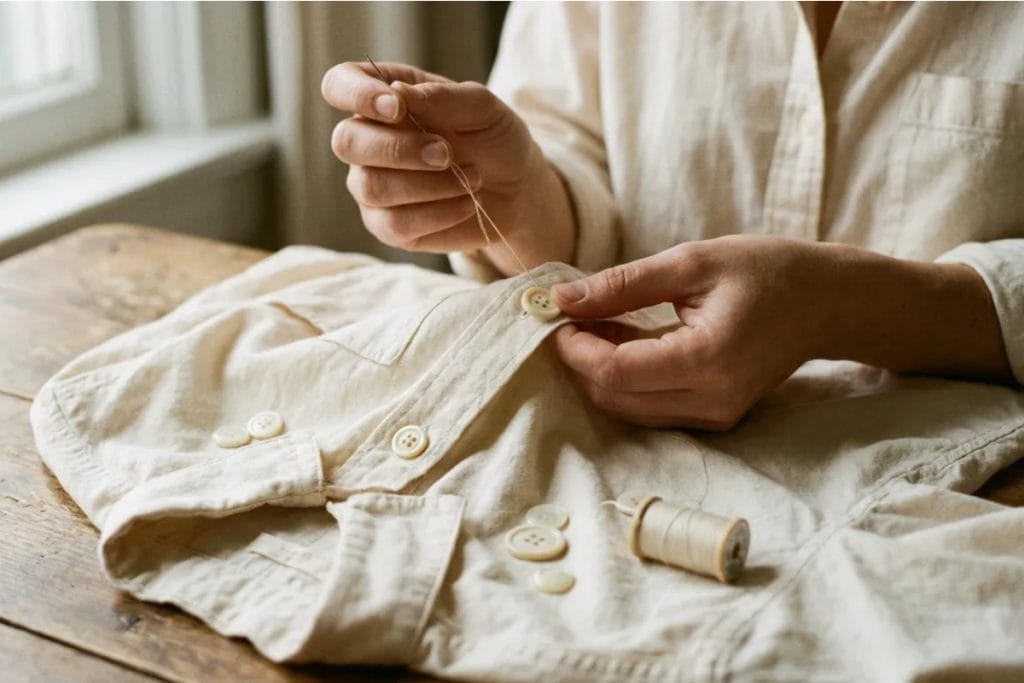
Quick answer: sewing on a button takes about five minutes and just four things: the button, a needle, matching thread and a small pair of scissors. Thread the needle, knot the end, and bring it up through the fabric where the button sits. On a two- or four-hole (sew-through) button, stitch down through the holes six to eight times, keep it a touch loose, then wind the thread underneath to form a small shank and knot off. On a shank button, which carries a loop on the back instead of holes, pass the needle through the loop, repeat, and finish the same way. That is the whole job.
Few things sink the heart quite like spotting a button on the floor an hour before you have to leave. The good news is that putting it back is about the simplest repair there is, and once you have done it the once, you will wonder why you ever left it to anyone else. Here is what you need, how to sew on both main types of button by hand, a quick way to do it by machine, and a handful of tricks that keep buttons from working loose in the first place.
What You’ll Need
- The button — the original, or a close match in the same size so it still passes through the buttonhole.
- A hand-sewing needle — a standard sharp needle handles most fabrics; reach for a thicker one on heavy coats.
- Thread — all-purpose polyester or cotton in a color that matches the garment or the existing stitching.
- Small scissors — for clean thread ends.
- A pin, toothpick or matchstick (optional) — laid across the button to hold a little slack while you stitch.
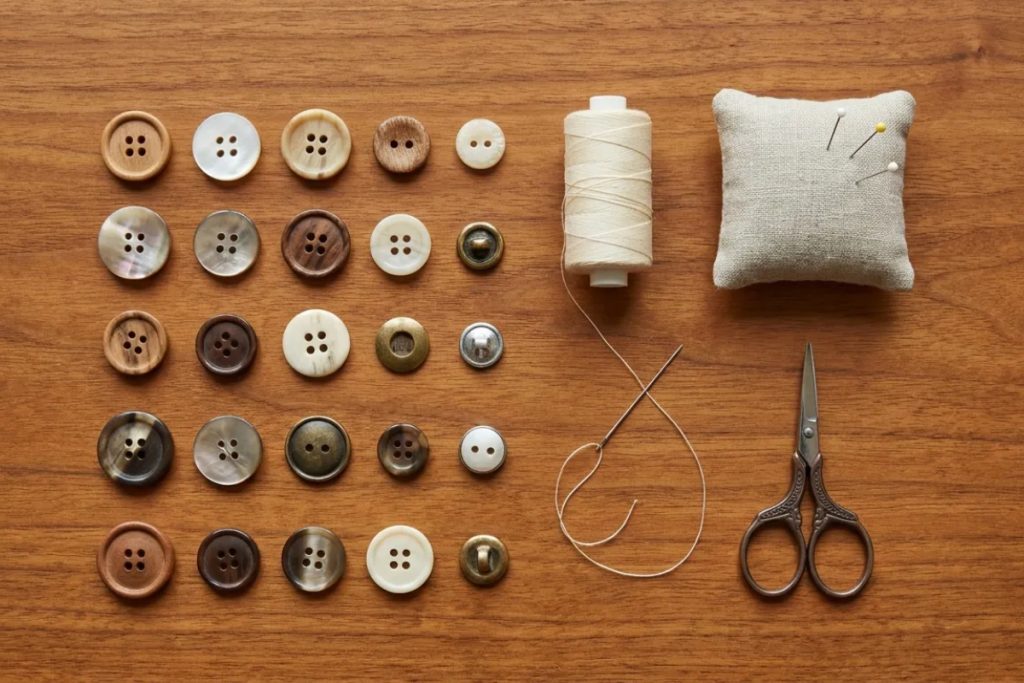
What Are the Two Main Types of Button?
Before you thread a needle, turn the button over, because the back is what decides how you attach it. A sew-through button has two or four holes on the front and lies flat against the fabric. A shank button has a smooth face and a small loop, called the shank, on the back, and you stitch through that loop rather than through holes. Everyday shirts and blouses usually take sew-through buttons, while coats, chunky knits and decorative buttons often sit on a shank. For the full comparison, our shank vs sew-through guide lays it out.
How Do You Sew On a Sew-Through Button?
- Thread the needle with about 60cm of thread, bring the two ends together and knot them, so you’re stitching with a double strand for strength.
- Bring the needle up through the fabric from the back to the front, right where the button should sit.
- Slide the button down the needle to the fabric. Lay a pin or toothpick across the top, between the holes, so the button isn’t stitched down too tight.
- Take the needle down through the opposite hole and back up through the fabric. On a four-hole button, work both pairs to make two parallel bars or a cross, whichever look you prefer.
- Repeat six to eight times, until the button feels secure.
- Bring the needle up between the button and the fabric, slide out the pin, and wind the thread tightly around the stitches three or four times to build a small thread shank. That little stem gives the button room to sit over the buttonhole.
- Pass the needle to the back, finish with two or three small stitches, then knot and trim.
How Do You Sew On a Shank Button?
- Thread and knot the needle the same way, using a double strand.
- Bring the needle up from the back of the fabric at the button mark.
- Pass it through the shank loop, then back down through the fabric close to where it came up.
- Repeat through the loop six to eight times, keeping the button snug but not strained.
- Wind the thread a few times around the stitches beneath the button, then knot off on the back and trim. Since the shank already lifts the button off the fabric, there’s no need to add a thread shank of your own.
Can You Sew a Button On by Machine?
Yes, if your machine has a button setting. Lower or cover the feed dogs, fit a button foot, switch to a zigzag stitch and adjust the width so the needle clears both holes. Sit the button under the foot, hand-turn the wheel for the first swing to check the needle lines up, then stitch. It’s quick for four-hole buttons on lighter fabric, though for coats and shank buttons, hand-sewing still gives you the most control.
How Do You Choose Thread and Needle?
Match the thread color to the garment, or to the stitching on the other buttons, and the repair all but disappears. All-purpose polyester thread is strong with a little give, which suits most clothes, while heavier button thread is worth reaching for on coats, jackets and bags. For the needle, a fine sharp handles shirting and blouses, and a thicker one pushes through denim, wool and canvas without bending.
How Do You Stop Buttons Falling Off?
- Sew with a double strand and finish with a proper knot on the back, every time.
- Add a thread shank on sew-through buttons so they aren’t pulled flat against the fabric.
- While you’re there, go over the neighboring buttons; when one lets go, the others are often loosening too.
- For buttons under a lot of strain, a tiny dot of clear fray sealant on the back knot keeps it from working loose.
Frequently Asked Questions
How long does it take to sew on a button? About five minutes by hand, once the button, needle and thread are ready.
Which way do you stitch a four-hole button? Two parallel bars or a cross both hold well, so it comes down to the look you want.
Do you need a thread shank? On a sew-through button, yes: winding thread underneath gives it room to sit over the buttonhole. A shank button already has that lift built in.
What thread should you use for sewing on buttons? All-purpose polyester for most clothes, and heavier button thread for coats, jackets and bags.
How do you attach a button without sewing? You can’t stitch one on without a needle, but no-sew button covers clip over an existing button, and no-sew snaps or a little fabric glue can hold a button temporarily in a pinch.
Can I replace a shank button with a sew-through one? Often yes, as long as the size still fits the buttonhole. Just remember a sew-through sits flatter while a shank sits slightly raised.
Rule of Thumb
Double the thread, hold a little slack with a pin, and build a small thread shank on flat buttons. Those three habits are what separate a button that lasts from one that’s back on the floor next week.
Where to Buy Buttons
Need a single replacement or a whole new set? Browse the full button collection for sew-through and shank styles in every size, or add some character with decorative buttons, then match the size to your buttonhole before you stitch. Buying for a shop or brand? Our buttons come in wholesale and bulk orders too, with trade pricing for boutiques, makers and studios, so get in touch for a wholesale quote.
Get in Touch
Stuck on a tricky repair, or after a wholesale quote? Our customer service team is happy to help.
- Email: [email protected]
- Phone: +86 158-8823-7906
- Address: No. 163, Hanbu Road, Qiaoxia Town, Yongjia County, Wenzhou City, Zhejiang Province, China, 325106
Recommended Reading
- Types of Buttons: A Guide to Styles, Materials and How to Choose