
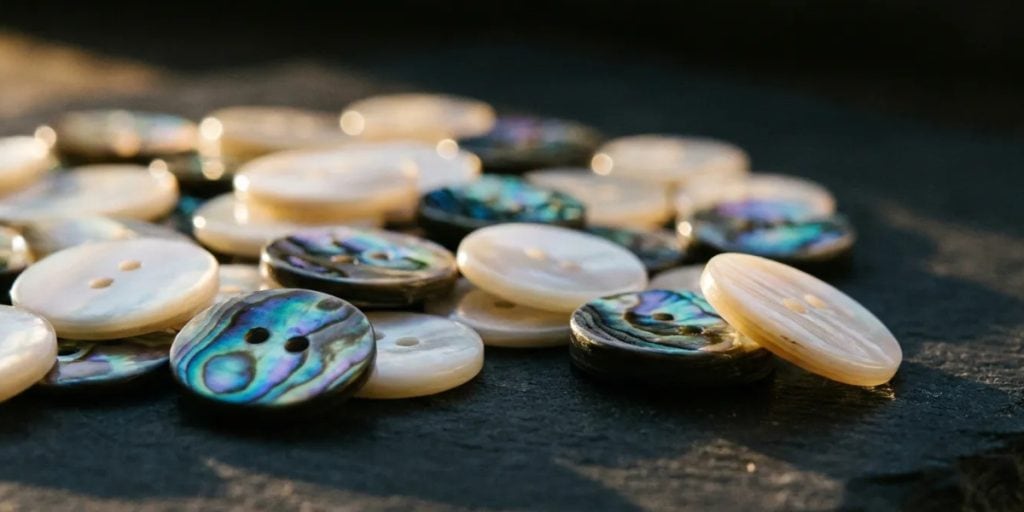
Quick answer: mother of pearl buttons are cut from the iridescent inner layer of a real shell. The simplest way to tell them from plastic imitations is to touch one. Real shell stays cool against your skin for several seconds; plastic warms up almost immediately. Look at the back too, because a genuine shell button carries the same grain front and back, while a printed imitation does not.
Pick up a well-made shirt and watch what your hand does. It turns a button over. You did not decide to do that, and you probably could not say what you were checking for, but something in the weight and in the way light travels across the face registered as different. Nine times out of ten you are holding mother of pearl. That half-second reflex is why shirtmakers have stayed with it for a hundred and fifty years, while nearly everything else about a shirt got cheaper.
Plastic has become very good at imitating it. Some of what sells today will fool a photograph completely, and a fair amount of it is described as “shell” without anyone technically lying. None of it fools your hand.
At a Glance
- What it is: Nacre, the iridescent inner lining of a shell
- The touch test: Real shell stays cool, plastic warms in a second
- Check the back: Genuine shell shows grain on both faces
- Expect variation: No two are identical, and that is the point
- Sizes: 10mm for cuffs and blouses, up to 25mm for coats
- Large means expensive: A 25mm button needs a much bigger shell
- Care: Keep away from bleach, solvent and direct heat
- Worth it on: Shirts, blouses, knitwear, occasion pieces
What Are Mother of Pearl Buttons?
Mother of pearl is the common name for nacre, the smooth, iridescent material a mollusc lays down on the inside of its own shell. It is the same substance a pearl is made of, which is where the name comes from. A button is cut straight out of that layer with a core drill, then ground flat, drilled and polished.
Nothing is applied to the surface. The button is cut, not molded, so the shimmer is structural, built into microscopic layers of the nacre itself, and it behaves nothing like a printed finish the moment you tilt it.
Worth knowing before you shop: a shell is curved, and only part of it is flat enough to use. A 10mm button comes out of almost any decent shell. A 25mm button needs a far bigger one, and most of that shell becomes waste getting there. So the price does not climb gently with size. It steps. Moving from 18mm to 25mm can cost you more than doubling your quantity would, and it catches people out every time.
How Can You Tell Real Shell From Plastic?
We get asked this more than anything else, almost always by someone who paid shell prices once and worked out the truth later. Five checks will settle it. Three of them you can do standing in a shop with the packet still sealed.
Touch it. Nacre pulls heat away from your skin, so a real shell button feels distinctly cool and stays that way for a few seconds. Plastic reaches your body temperature almost at once. Hold one against the inside of your wrist if you are not sure. This single test catches most imitations.
Tilt it under a light. On real shell the iridescence moves, and the bands of color travel across the surface as the angle changes. A printed or pearlized plastic finish tends to sit still, or slides as one flat uniform sheet with no layers inside it.
Turn it over. Genuine shell is the same material all the way through, so the back shows the same grain and figure as the front, usually less polished. Imitations very often have a plain, uniform back, because only the visible face was treated.
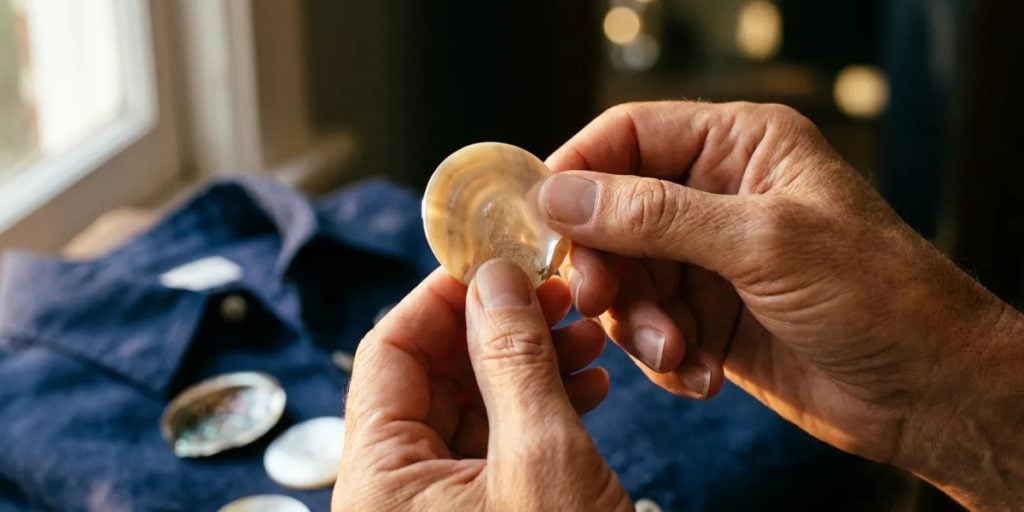
Weigh it in your palm. Shell is denser than most plastics. Set a shell button and a resin button of the same diameter side by side and you will feel it before you can explain it.
Then, last, stop looking for perfection. A faint chalky patch, a grain line running off-center, one button in the set a shade warmer than its neighbor. Customers report these to us as faults. They are the opposite. Faking that convincingly would take real effort, and almost nobody bothers, so uniformity is the warning sign and the variation is the proof.
One test we would ask you to skip is the hot needle. It works. It also destroys the button, and if the answer comes back as real shell, you have just ruined something that was fine.
Which Type of Shell Should You Choose?
Shells are not interchangeable, and choosing the wrong one is how a good button ends up on the wrong shirt.
- Natural white shell does the quiet work. Milky white, low iridescence, the default on dress shirts and blouses for as long as anyone has been making them properly. It disagrees with almost no fabric, which is the whole reason it has survived every trend since. Our natural white shell buttons run through eight sizes, 10mm to 25mm.
- Abalone stops people. Deep blue-green shot through with pink and violet, genuinely no two alike. Wrong on a business shirt. Excellent on a statement cardigan, a denim jacket, anything where the buttons are meant to be looked at.
- Blue-lip and smoke shell land in between, cooler, carrying a gray or bluish cast. They earn their keep on navy, charcoal and indigo, where bright white shell can read a little stark.
- Half-round shell changes the shape, not the material. A domed face gathers light along a curve instead of across a flat plane, and the effect is dressier, which is why it turns up on blouses and occasion wear.
The shell button collection has all of them side by side if you want to compare.
What Size Do You Need?
Measure straight across the face of an existing button, in millimeters. Shell is normally sold in a wider range of sizes than other materials, because it is used on such a range of garments.
| Size | Typical use |
|---|---|
| 10mm – 11.5mm | Shirt cuffs, blouse plackets, lightweight fabric |
| 12.5mm – 15mm | Shirt fronts, dresses, fine knitwear |
| 18mm – 20mm | Cardigans, heavier shirts, jackets |
| 23mm – 25mm | Coats, windbreakers, statement pieces |
One thing specific to shell that catches people out: it is harder than resin, and slightly more brittle at the edge. If the buttonhole is tight, a resin button will simply force its way through for years. A shell button will chip along the rim instead, usually after a few months, and usually on the button you use most. Give shell a fraction more room than you would give plastic.
Our button size guide has the full measuring method and the ligne conversion table.
Are They Worth the Extra Cost?
Depends entirely on the garment, and the answer is not always yes.
On a shirt it is hard to think of a cheaper change that does more. Buttons are the only hardware a shirt has. They run down the center of the chest at eye level, and they are the first thing anyone’s fingers find. Replacing them on a plain shirt costs a small fraction of what the shirt did, and it changes how the whole piece reads across a table.
On a coat that spends winter outdoors, less so. Shell is lovely and it is not the toughest thing we make. Metal belongs on garments that get handled roughly.
On children’s clothing, put the money somewhere else entirely. Buy resin. It will go through a hot wash twice a week for two years and not care.
A button seller is not supposed to talk you out of the expensive option. But shell on the wrong garment comes back to us as a complaint, and we would rather have the sale we get to keep.
Will They Survive the Washing Machine?
Yes, with a little care. They ask more of you than plastic does, and pretending otherwise would only earn us a disappointed email six months from now.
Water is not the enemy. Chemistry and heat are. Bleach, strong solvents, perfume sprayed straight onto a placket, long soaks in hot water, all of it dulls the luster over time. So does an iron set down on the button face, which leaves a flat shiny mark that does not come out.
In practice: a cool machine cycle is fine, better still with the garment inside a laundry bag. No bleach, ever. Iron around the buttons, never over them. And if a piece goes to the dry cleaner regularly, mention that the buttons are shell, because some solvents treat nacre more gently than others.
Done that way, shell buttons routinely outlive the garment they were sewn onto. We have seen buttons cut off worn-out shirts in the 1960s and put back into service, still bright.
How Do You Sew Them On?
The method is the same as any sew-through button, with two adjustments.
First, do not pull the thread tight against the fabric. Shell will not flex the way plastic does, so a button clamped hard onto thick cloth throws every bit of the strain onto its rim. Leave a small thread shank underneath, about as deep as the fabric is thick, and let the button sit up and move a little.
Second, match your thread to the stitching on the other buttons, not to the shell. White thread on a white shell button vanishes, which sounds like the goal and usually just looks flat. Copy whatever the garment came with. The full method is in our guide to sewing on a button.
Frequently Asked Questions
Are mother of pearl and shell buttons the same thing? Effectively yes. Mother of pearl is the iridescent inner layer of the shell, and it is the part buttons are cut from. Some sellers use “shell button” more loosely to include the duller outer layers or imitations, so it is worth checking the material description.
How do I know if a button is real mother of pearl? Touch it first. Real shell stays cool against your skin for several seconds and plastic does not. Then turn it over and check whether the grain continues on the back, and tilt it to see whether the iridescence moves in layered bands.
Why do the buttons in my set not match each other? Because they were cut from real shell, and shell varies. Color, grain and depth of shimmer differ from piece to piece and even across a single button. A set that matches perfectly is usually a sign the material is not natural.
Are shell buttons fragile? Harder than resin, but less forgiving. They chip at the rim instead of snapping. Most of the damage we hear about traces back to a buttonhole cut too tight, or an iron pressed straight onto the face.
Can shell buttons go in the washing machine? On a cool cycle, yes, ideally inside a laundry bag. Bleach, strong solvents and direct heat are what cause damage, not water itself.
Which shell type suits a dress shirt? Natural white. It is quiet, it works with every fabric color, and it is what tailored shirting has used for generations. Save abalone for pieces where you want the buttons to be seen.
Why are large shell buttons so much more expensive? A button is cut from the flat usable area of a curved shell. Large buttons need much larger shells and waste far more material along the way, so cost climbs in steps as the diameter grows instead of rising in proportion to it.
Do shell buttons yellow with age? Good nacre does not yellow the way old plastic does. What can happen is a gradual dulling of the luster from repeated exposure to detergent, solvent or heat, which is why the care advice matters.
Rule of Thumb
Buy shell for the things people look at closely and touch: shirts, blouses, occasion pieces, anything with a collar. Buy metal or resin for the things that live outdoors or go through a hot wash.
Where to Buy Mother of Pearl Buttons
Browse the full shell button collection, including natural white, abalone and half-round styles, or go straight to our natural white shell buttons, available in eight sizes from 10mm to 25mm with 50 pieces per set. Every listing states the diameter in millimeters and the hole configuration, so you can check against a button you already have before ordering.
The rest of the range, in metal, resin and natural wood, is in the full collection.
Can You Buy Mother of Pearl Buttons Wholesale?
Yes. As a button manufacturer, we supply natural shell buttons for wholesale and bulk orders, with trade pricing for shirtmakers, tailors, fashion brands, alteration services and craft studios. Shell is graded by thickness and by evenness of color, and we can match a grade across repeat orders so a production run stays consistent. We ship factory-direct internationally. Tell us the sizes, grades and quantities you need and we will reply with a quote.
Get in Touch
Have a question about grades, sizing or matching an existing button? Our customer service team is happy to help.
- Email: [email protected]
- Phone: +86 158-8823-7906
- Address: No. 163, Hanbu Road, Qiaoxia Town, Yongjia County, Wenzhou City, Zhejiang Province, China, 325106