
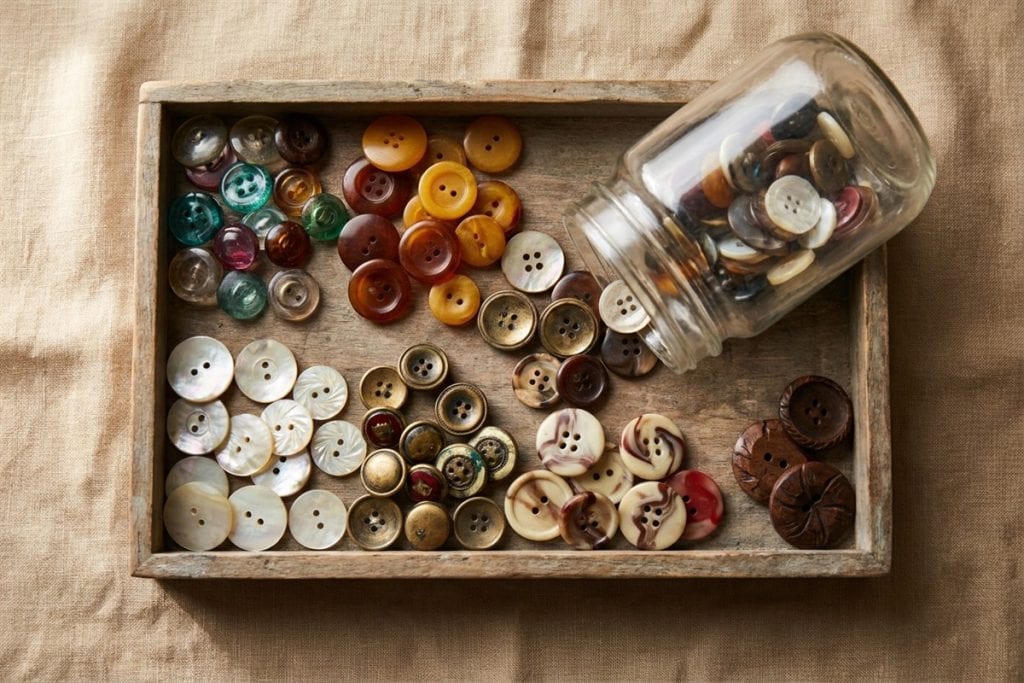
Quick answer: Vintage buttons are buttons made roughly 20 to 100 years ago, most often from glass, Bakelite, celluloid, casein, metal, shell or early plastics. You identify them by three things: what the button is made of, how the back and shank are built, and the small tooling marks that older machines left behind. Read those three clues together and you can usually place a button within a few decades.
A jar of old buttons costs almost nothing at a flea market, and somewhere in it there is usually one button that is worth more than the jar. Sorting them is the fun part. This guide walks through the material tests collectors actually use, how to read the back of a button, what makes one worth keeping, and what to do when you need four matching buttons and the jar only gave you three.
At a Glance
- Vintage: roughly 20 to 100 years old
- Antique: over 100 years old
- Common materials: glass, Bakelite, celluloid, casein, metal, mother of pearl and shell, wood, vegetable ivory, early plastics
- Main clues: material, back and shank type, mold seams, wear pattern, weight and temperature
- Quick tests: hot water smell test, weight and temperature test, loupe check on the back
- Most collectible: hand painted glass, enameled metal, carved shell, figural and realistic designs
- Good for: collectors, garment repair, and vintage-inspired sewing projects
What Are Vintage Buttons?
Vintage buttons are buttons produced roughly between the 1920s and the 1990s, while buttons over a hundred years old are usually called antique. The line is loose and dealers use it loosely, so treat any listing date as a starting point rather than a fact. What matters more than the label is the material and the construction, because those are the things you can actually verify in your hand.If the terminology is new to you, our guide to the main types of buttons explains how each style is built.
How Do You Identify Vintage Buttons?
Start with the material, then the back, then the finish. Almost every dating clue falls into one of those three.
Material
Pick the button up and notice its temperature and weight before you look at it. Glass stays cool and feels heavy for its size. Bakelite feels dense and warms up quickly in your palm. Celluloid is startlingly light and thin. Modern injection molded plastic feels light, uniform and slightly hollow. This one-second test sorts a pile faster than anything else.
Back and Shank
The back tells you more than the face. A hand soldered wire loop, a rough metal pad glued to the back, a self-shank molded in one piece, a four-hole plate with slightly uneven holes: each belongs to a different manufacturing era. Older metal buttons are often two-piece, with a separate face and back crimped together, and you can see the seam around the rim. Machine perfect, seamless backs usually mean modern.If you are unsure what you are looking at, compare it with our breakdown of shank vs sew-through buttons.
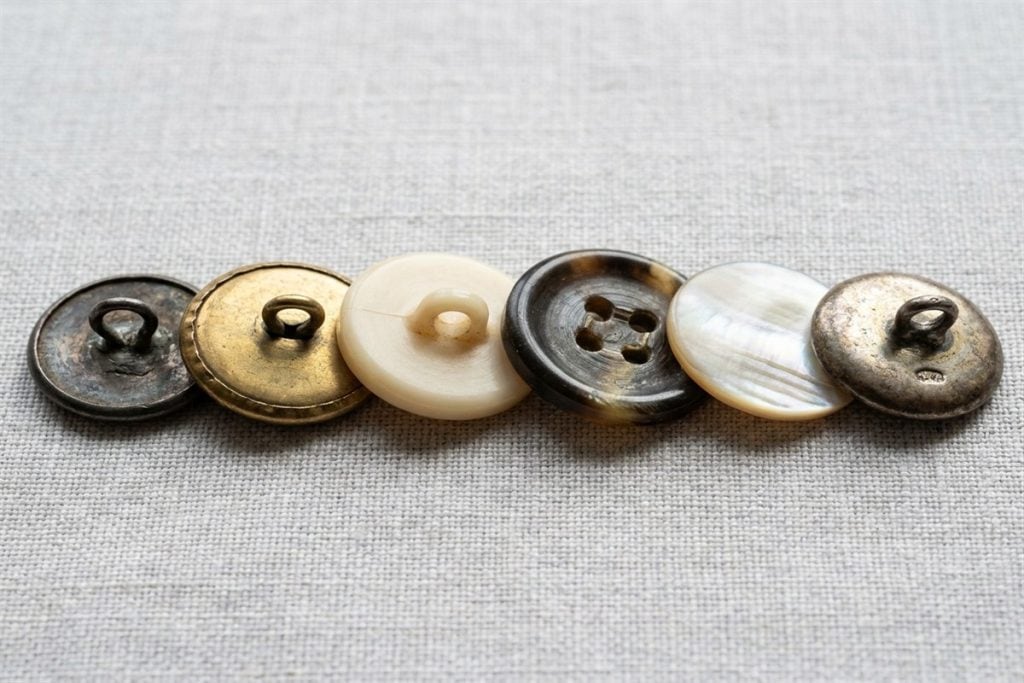
Mold Seams and Tooling Marks
Look around the edge under a loupe. Older glass buttons often show a faint seam or a tiny sprue mark where the glass was cut from the rod, plus small bubbles trapped inside. Older molded plastics show a light seam that was hand trimmed rather than machine cut. Reproductions tend to be too clean.
Wear
Genuine age wears unevenly. The high points of a design go dull first, thread grooves appear inside the holes, and paint thins where fingers touched it. Artificial aging is applied evenly, sits in the recesses, and looks the same on every button in the set.
What Are Vintage Buttons Made Of?
Use this table to place a button by material.
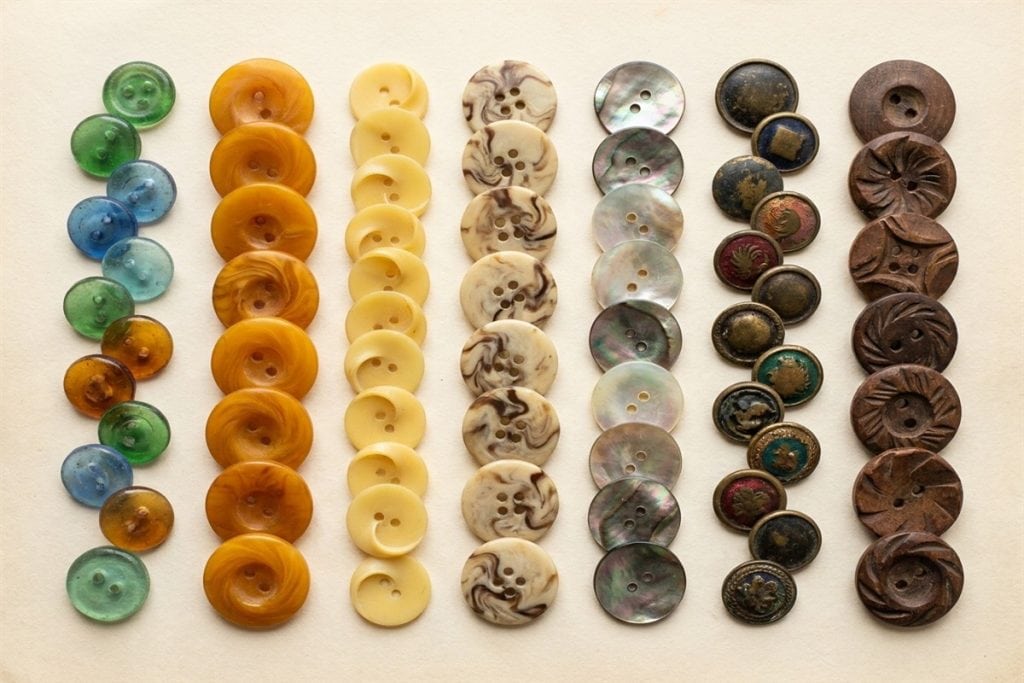
| Material | How it looks and feels | Quick clue | Typical era |
|---|---|---|---|
| Glass | Cool, heavy for its size, glossy, sometimes with tiny internal bubbles | Stays cool against your skin; a light tap sounds sharp | 1800s to 1950s |
| Bakelite | Dense, warm, deep butterscotch, amber, red or dark green | Run it under hot water for 30 seconds; it gives off a faint chemical smell | 1920s to 1940s |
| Celluloid | Very light and thin, sometimes warped or yellowed | Faint camphor smell in hot water; keep it away from heat, it is flammable | 1870s to 1930s |
| Casein | Mottled or marbled with a waxy sheen | Smells faintly of burnt milk in hot water | 1900s to 1940s |
| Shell and mother of pearl | Cool, iridescent, uneven thickness, natural layering on the back | The pattern never repeats from button to button | Any era |
| Metal | Heavy and cool, may be tarnished, often two-piece | Look for a soldered wire shank and a maker’s mark on the back | 1700s to now |
| Wood and vegetable ivory | Light, warm, fine grain or tiny pores | Vegetable ivory takes dye unevenly and shows a slightly pitted surface | 1880s to 1930s |
| Modern plastic and resin | Light, uniform, seamless, identical across the set | Every button in the pack is exactly the same | 1950s to now |
How Can You Tell Bakelite From Ordinary Plastic?
Hold the button under hot running water for about half a minute, then smell it straight away. Bakelite gives off a faint sharp chemical note, casein smells like burnt milk, celluloid smells of camphor, and modern plastic smells of nothing at all. Bakelite is also noticeably heavier and denser than it looks, and it never comes in true white because it yellows with age. Do not use flame or a hot needle on a button you care about, and never on celluloid.
What Makes a Vintage Button Valuable?
Four things push the value up: material, workmanship, subject and condition. Hand painted glass, enameled metal, carved shell and figural buttons shaped like animals, flowers or objects sit at the top. A maker’s mark on the back adds value because it makes the button attributable. Condition matters more than most people expect, since chips, crazing and missing shanks cut the value sharply. And a complete matched set of six or eight is worth far more than the same buttons sold loose, because a set can actually be used on a garment.
How Do You Clean and Store Vintage Buttons?
Go gently and test on the least interesting button first. Wipe metal and glass with a soft dry cloth, and use only a barely damp cloth on anything painted or enameled. Keep shell, wood and early plastics away from soaking, detergent and heat, since water swells wood and heat distorts celluloid. Store buttons in a lidded box or a divided tray rather than a sealed plastic bag, because celluloid and casein need air, and keep them out of direct sunlight so colors stay true.
Can You Still Sew With Vintage Buttons?
Yes, and old buttons look excellent on a plain modern coat or cardigan. Two practical cautions. First, check every shank and hole edge for cracks, since a chipped hole will cut through thread within a season. Second, treat vintage buttons as hand wash only and take them off before machine washing or dry cleaning anything valuable. If you love the look but the garment gets washed weekly, use a vintage-inspired reproduction and keep the original in the box.
What If You Cannot Find Enough Matching Vintage Buttons?
This is the usual problem: the jar gives you three good buttons and the coat needs six. Rather than hunting for months, most sewers switch to vintage-inspired buttons made in the same style, so the whole garment matches and every button is strong enough for daily wear. Our range of vintage-inspired buttons covers the looks people search for most in old button jars, including enamel-look metal, faux pearl, resin in marbled and carved patterns, and natural shell, in matched packs and repeatable sizes.
Frequently Asked Questions
What are vintage buttons made of? Most often glass, Bakelite, celluloid, casein, metal, shell or wood. Material is the single most reliable dating clue, so identify it before anything else.
How can I tell a vintage button from a reproduction? Check the back and the wear. Reproductions have clean modern shanks, seamless machine finished edges, and even artificial aging, while genuine old buttons wear unevenly on the high points and often show hand finishing marks.
Are vintage buttons worth money? A few are. Hand painted glass, enameled metal, carved shell and figural designs in good condition attract collectors, while ordinary plastic and shirt buttons are sold by weight. Condition and a complete matched set matter as much as age.
Is it safe to wash vintage buttons? Wipe them with a soft dry or barely damp cloth. Avoid soaking, bleach, solvents and heat, particularly with celluloid, casein, painted metal and wood.
What sizes do old buttons come in? Most fall between 11mm and 28mm, with coat buttons at the larger end. Measure the button across the face and measure your buttonhole before buying replacements, and use our button size guide to convert the measurement into a size.
Can I order vintage-style buttons in bulk? Yes. Our vintage-inspired buttons are available for wholesale and bulk orders with trade pricing, alongside smaller packs for home sewing.
Rule of Thumb
If it is cool and heavy, think glass. If it is warm and dense, think Bakelite. If it is light and thin, think celluloid. And if every button in the set is identical, it is modern.
Where to Buy
Looking for the vintage look without hunting through jars? Browse our vintage buttons in enamel-look metal, faux pearl, marbled resin and natural shell, in matched packs and sizes from 11mm to 28mm, and pick the finish that suits your project. Get in touch using the contact details at the bottom of this page and we will be happy to help you match an existing button.
Can You Buy Vintage Buttons Wholesale?
Yes. As a button manufacturer, we offer our vintage-inspired buttons for wholesale and bulk orders, with trade pricing for boutiques, fashion brands, tailors and craft studios. Whether you are stocking a shop, fitting out a production run or filling craft kits, we ship factory-direct internationally. Tell us the styles, sizes and quantities you need, using the contact details below, and we will reply with a wholesale quote and bulk availability.
Get in Touch
Have a question about our vintage-inspired buttons, or want a wholesale quote? Contact our customer service team and we will be happy to help.
- Email: [email protected]
- Phone: +86 158-8823-7906
- Address: No. 163, Hanbu Road, Qiaoxia Town, Yongjia County, Wenzhou City, Zhejiang Province, China, 325106
Recommended Reading
- The Complete Guide to Buttons: Types, Materials and How to Choose
- Sew-Through vs. Shank Buttons: Which One Should You Use?
- Button Sizes Explained: How to Measure and Choose