
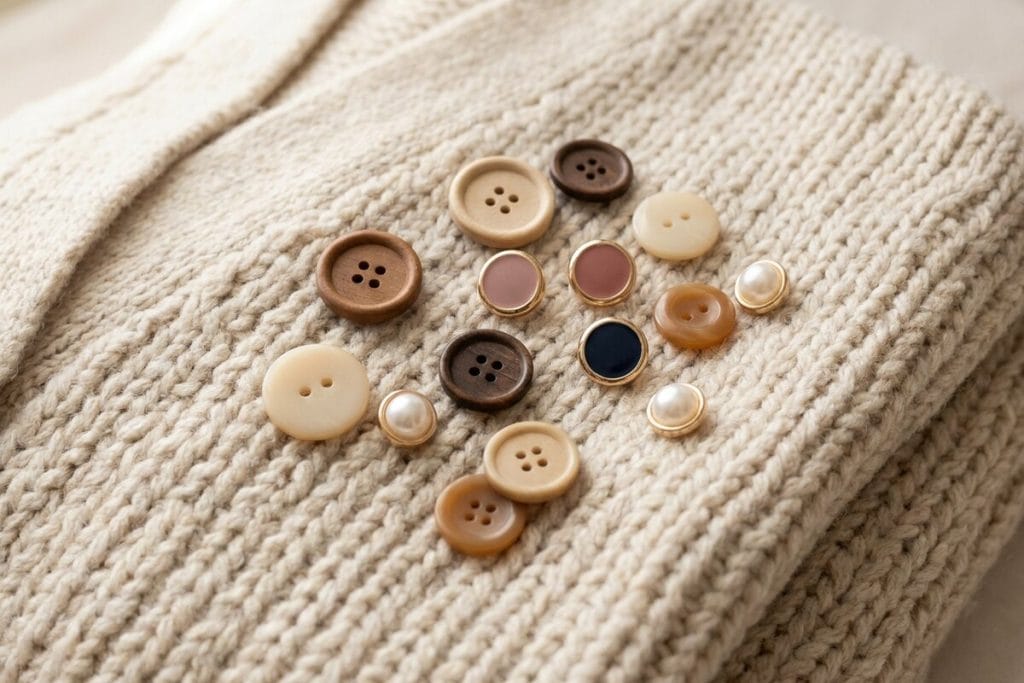
Quick answer: Cardigan buttons are the buttons down the front of a knitted cardigan, usually 15mm to 20mm. What sets them apart from shirt or coat buttons is weight. Knit stretches and a heavy button drags the placket out of line, so the useful range is light buttons on a shank or with wide holes, sewn on with a small stay button behind each one.
The buttons are almost always the first thing a cardigan gets wrong. Mills buy them by the kilo, and a thin dyed plastic disc costs them about a penny, so that is what gets sewn on. You notice it after four or five washes, when the dye has gone chalky and one button has cracked through a hole. The knit itself is usually still fine. Replacing six buttons takes an hour and costs less than lunch, and it is the only alteration I know of that is completely reversible. This guide covers what makes a button suitable for knitwear in the first place, how to size one against a buttonhole that stretches, and the one stitching trick that stops the holes from opening up. For a wider look at materials, our guide to the types of buttons sets them side by side.
At a Glance
- Typical size: 15mm to 20mm on a standard cardigan, 23mm to 25mm on a chunky knit
- Weight: Light. Anything that feels heavy in the palm will pull the placket down
- Back: Shank for thick or loose knits, sew-through for fine gauge
- Material: Resin, wood, enamel on metal, faux pearl and glass all work
- Thread: All-purpose polyester, doubled. Not embroidery floss
- Stay button: A small flat button sewn on the reverse behind each front button
- How many: Five to seven for most cardigans, nine or ten for a long one
What Are Cardigan Buttons?
Cardigan buttons are just buttons chosen for knitwear rather than woven cloth, and the distinction matters more than it sounds. A woven shirt holds a button in place because the fabric does not move. Knit moves constantly. Every stitch is a loop that can be pulled open, which means the button is not resting on a surface so much as hanging from a hole that will stretch to whatever size you force it to.
So the category is defined by what it rules out. Heavy metal buttons sink into the stitch and leave a dimple. Buttons with sharp edges on the back saw through yarn over a season. Anything with a foot smaller than the hole will eventually work its way through on its own. Within those limits almost any of our decorative buttons will do the job, which is why cardigans are the easiest garment to make interesting.
What Makes a Good Cardigan Button?
Pick one up and weigh it in your hand. That is most of the test. A button for a fine merino cardigan should feel like almost nothing, around a gram or two, because anything above that will show as a slight droop in the placket after a few hours of wear. On a chunky wool knit you can go heavier, since the fabric has the body to carry it.
The second thing is the back. Run a fingertip over it. A good knitwear button is smooth underneath, with either a rounded shank loop or holes that have been drilled and polished rather than punched and left sharp. Cheap plastic buttons often have a burr around the hole that you can feel as a scratch, and that burr is what cuts the yarn.
Third, and people skip this one, is whether the button can go through a buttonhole that has gone soft. Cardigan buttonholes loosen with age. A domed or ball-shaped button slips through a loose hole far too easily and the cardigan gapes. A flat button with a slight edge holds better. If an old cardigan keeps falling open, the buttons are usually the reason rather than the holes.
Why Replace the Buttons on a Cardigan?
Because the ratio is absurd. A plain cream cardigan with six chalky plastic buttons looks like a cheap cardigan. The same cardigan with six wooden buttons looks like something bought deliberately, and the change costs a few dollars and an hour at the kitchen table. Nothing else you can do to a garment pays back at that rate.
There is also the repair case, which is more common than the styling one. One button cracks, the original is long discontinued, and a near match looks worse than no match. Replacing the whole front with one set solves it properly. Keep the old ones in a tin anyway.
And one honest caveat. Some cardigans should be left alone. If the buttons are good quality and the knit is a strong color, swapping them for something more interesting usually makes the piece look fussy rather than better. The buttons are worth changing when they are the weak part, not just because they are changeable.
How Do You Choose Cardigan Buttons?
Weight
This is the decision that goes wrong most often, and it goes wrong because weight is invisible in a product photograph. A 20mm solid metal button can weigh five or six times what a 20mm resin one does. On a fine cardigan that difference shows up within an hour: the placket pulls into a slight curve, the buttonholes elongate, and the front edges stop meeting.
As a rough rule, match the button to the yarn. Fine gauge merino or cotton wants resin, wood or a hollow-backed metal button. Mid-weight lambswool handles most things. A chunky hand-knit will carry almost anything you put on it, including heavier metal buttons, because the fabric is doing the structural work.
Size
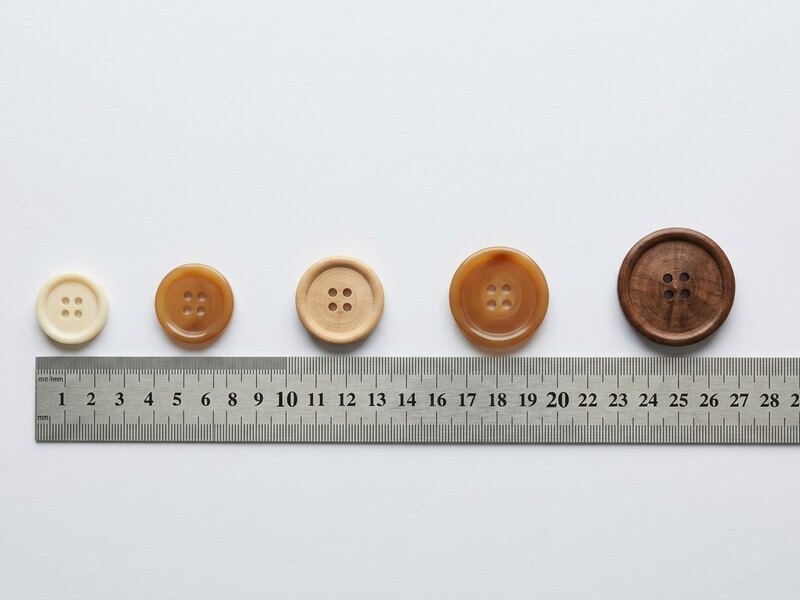
Most cardigans take 15mm to 20mm, which is 24 to 32 ligne. Fine gauge and children’s cardigans drop to 11mm or 13mm. Chunky knits run to 23mm or 25mm and sometimes further.
Measure the buttonhole, not the old button, and measure it relaxed rather than stretched. Lay the cardigan flat, let the hole sit at its natural length, and read it with a ruler. The button should be a shade wider than that relaxed measurement, because the hole will give when you push the button through and you want it to grip once released. If you buy exactly to the hole measurement the cardigan will come open when you sit down. Our button size guide covers the ligne system and how to measure a shaped button.
One thing specific to knitwear: the buttonholes on a cardigan are often not all the same size, especially on hand-knits. Measure two or three before ordering.
Back and Attachment
Shank buttons have a loop on the back, which lifts the button off the surface by a couple of millimeters. On knit that gap matters, because it gives the fabric underneath room to sit without being compressed, and it keeps the stitching off the face of the button. Use a shank on anything thick, anything loosely knitted, and on any button with a decorated front worth protecting.
Sew-through buttons with two or four holes sit flatter and suit fine gauge cardigans, where a shank would make the button stand away from the fabric and catch. Four holes spread the load better than two. If you are deciding between the two, shank vs sew-through goes through it properly.
There is a third option worth knowing about for anyone who does not want to sew. Clip-on button covers go over the buttons already on the cardigan and come off before the wash. They are not a long-term fix on knitwear, since the clip can distort a loose stitch, but for one evening they are fine.
Material
Wood is the default for anything casual and it is hard to get wrong, since it is light and warm against wool, and something like our wooden flower buttons sits at about a gram. Resin is the most versatile and comes in the widest color range. Enamel on metal gives you color with a harder surface, and it suits a cardigan being worn as a jacket. Faux pearl reads dressier and works on a cream or pastel knit, and if you want to know how a faux pearl finish differs from real shell, that comparison is here. Stone-set buttons sit at the dressy end, and the small ones hold up better on knit than the large ones. Our cat eye cardigan buttons are the compromise, since the stone is set flush rather than raised.
Avoid anything with a glued-on flat decoration. The glue does not survive repeated washing and the decoration comes off in the machine, usually in the first cold wash rather than the fiftieth.
How Many You Need
Count the buttonholes and add two. A standard cardigan has five to seven, a long or duster-length one has nine or ten, and a cropped cardigan might have three or four. The spares matter more here than on other garments, because knitwear buttons take more abuse and because color batches drift. Matching a single lost button eighteen months later almost never works.
If you are buying a pack of ten for a five-button cardigan, think about where the rest will go before you order. Cuffs take two. A matching cardigan takes another five. Otherwise five buttons sit in a tin for a decade, which is fine, but it is not a bargain.
How Do You Style Cardigan Buttons?
- Match the thread to the knit rather than to the button, so the stitching disappears and the button reads as deliberate
- Use wood or horn-look buttons on anything oatmeal, grey or navy, where the warmth of the material does more than color would
- Put something sparkly only at the top two or three buttons of a long cardigan, since the lower ones sit below the eye and are usually covered by a bag strap anyway
- Leave the bottom button off a long cardigan entirely if the hole has stretched, rather than fighting it
- Swap the cuff buttons to match the front, which takes ten minutes and is the detail people notice second
- Sew spares onto a plain tote or a hair clip, which is where button craft projects use up the leftovers
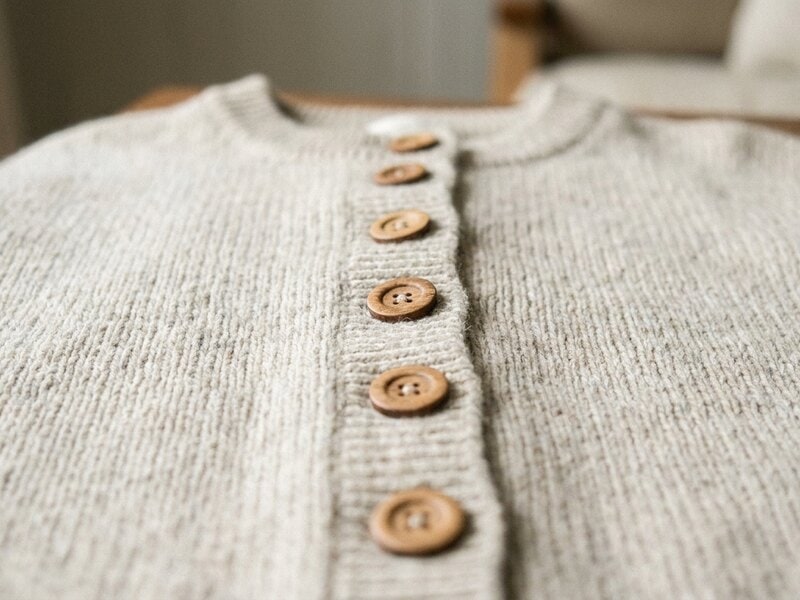
Buying for a shop or brand? Our cardigan buttons are also available for wholesale and bulk orders, with trade pricing for boutiques, knitwear labels and studios. Get in touch for a wholesale quote.
How Do You Sew Buttons Onto Knitwear?
- Mark each position with a pin through the buttonhole, working from the top down with the cardigan laid flat and buttoned, so the two fronts line up.
- Cut about 50cm of all-purpose polyester thread, double it, and knot the end. Doubled thread is strong enough; embroidery floss is too thick and will stretch the stitch.
- Bring the needle up at the mark, pass it through the shank loop or up and down through the holes, and go back down through the same small area of knit each time rather than spreading the stitches out.
- Hold a small flat stay button against the inside of the placket and catch it with every pass, so the thread goes through the front button, the knit and the stay button together. This is the step that matters. It spreads the pull across the stay button instead of concentrating it on four or five loops of yarn.
- After five or six passes, wind the thread three times around the stitches under the button to make a thread shank, then knot off against the stay button on the reverse.
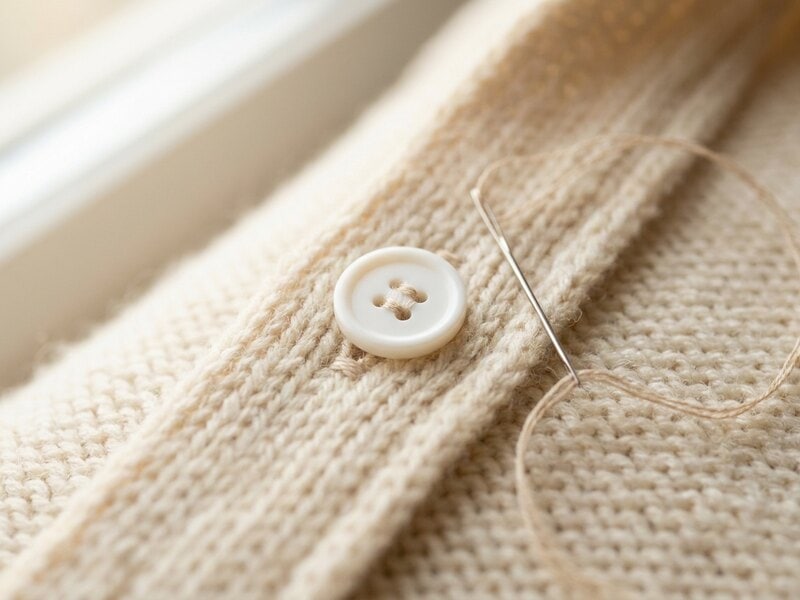
The stay button does not need to be pretty, only flat and a little smaller than the front button. Any plain shirt button from the tin will do. Without one, a loose knit will open up around the stitching within a season, and once a hole starts in knit it keeps going.
How Do You Care for Cardigan Buttons?
Wash the cardigan inside out on a wool or delicate cycle at 30 degrees or below, and put it in a mesh bag if the buttons have any decoration on them. Button the cardigan up before washing, which stops the front edges from stretching and stops buttons from catching on other items. Do not tumble dry knitwear with wooden buttons, since the heat dries the wood out and it will crack along the grain within a few cycles.
When you press the cardigan, press around the buttons rather than over them, and use a cloth. Resin softens at a lower temperature than most people expect, and a button-shaped shine on the front of a cardigan does not come out. Check the thread on each button twice a year, usually at the start of the season. A button caught loose takes two minutes; a button lost on a bus takes a whole new set.
Frequently Asked Questions
What size buttons do cardigans take? Most take 15mm to 20mm. Fine gauge and children’s cardigans drop to 11mm or 13mm, and chunky knits go up to 23mm or 25mm.
Should cardigan buttons be shank or sew-through? Shank on thick or loosely knitted cardigans, sew-through on fine gauge. Four holes spread the load better than two.
Can I use metal buttons on a cardigan? Yes on a chunky knit. On fine knitwear a solid metal button is usually too heavy and will drag the placket out of line.
What is a stay button? A small flat button sewn on the inside of the placket, directly behind the front button and caught by the same stitches. It stops the knit from tearing around the thread.
How many buttons does a cardigan need? Count the buttonholes and add two spares. Five to seven is typical, nine or ten on a long cardigan.
Can I put a cardigan with wooden buttons in the machine? On a cool wool cycle, yes. Do not tumble dry it, because the heat cracks the wood.
Can I order cardigan buttons in bulk? Yes. We supply wholesale and bulk orders with trade pricing, alongside smaller packs for home sewing.
Rule of Thumb
Weigh the button in your palm first and measure the relaxed buttonhole second. If the button feels heavy, it is wrong for the knit no matter how good it looks. And always use a stay button, even when the knit seems dense enough to manage without one.
Where to Buy
Browse our cardigan buttons in wood, resin, enamel on metal and faux pearl, in the 15mm to 25mm range that most knitwear takes. If you are unsure what suits a particular cardigan, send us a photograph and the buttonhole measurement using the contact details below and we will point you at something.
Can You Buy Cardigan Buttons Wholesale?
Yes. As a button manufacturer, we supply cardigan buttons for wholesale and bulk orders, with trade pricing for boutiques, knitwear labels, tailors and craft studios. We ship factory-direct internationally. Tell us the materials, sizes and quantities you need, using the contact details below, and we will reply with a quote and bulk availability.
Get in Touch
Have a question about cardigan buttons, or want a wholesale quote? Contact our customer service team and we will be happy to help.
- Email: [email protected]
- Phone: +86 158-8823-7906
- Address: No. 163, Hanbu Road, Qiaoxia Town, Yongjia County, Wenzhou City, Zhejiang Province, China, 325106
Recommended Reading
- The Complete Guide to Buttons: Types, Materials and How to Choose
- Sew-Through vs. Shank Buttons: Which One Should You Use?
- The Complete Guide to Button Sizes
- The Complete Buying Guide to Coat Buttons