
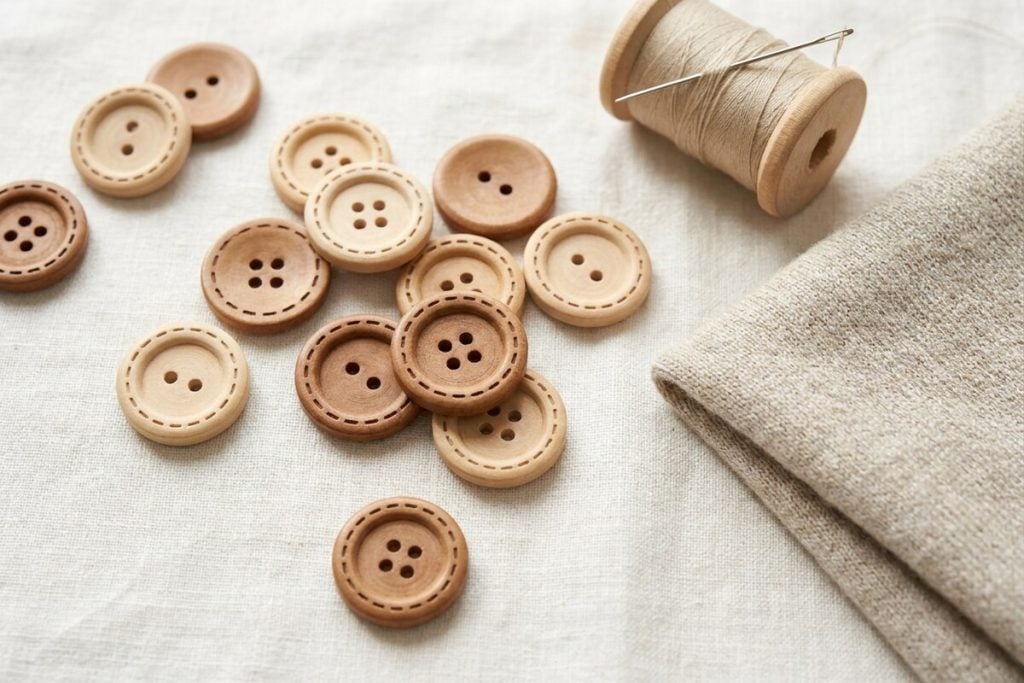
Quick answer: Natural wood buttons are lightweight sewing buttons cut from wood, with a smooth low sheen surface and a decorative dashed carved edge. They come in three designs, two hole and four hole, in five sizes from 10mm to 23mm, and suit shirts, knitwear, coats, dolls and all kinds of DIY sewing and craft projects.
Most shop-bought cardigans come with thin plastic buttons that go cloudy after a few washes. Swap them for wood and the same cardigan looks like it cost twice as much — the whole job takes about twenty minutes and one pack of buttons. Wood also happens to sit well against almost everything already in a wardrobe: oatmeal knits, washed denim, linen, corduroy. Below you will find what these buttons are made of, how to pick the size and hole count, and what to do at the washing machine. If you are still deciding between materials, our guide to the types of buttons lays them out side by side.
At a Glance
- Design: Round, with a carved dashed stitch edge
- Material: Natural wood, smooth low sheen finish
- Back: Two hole and four hole sew-through, flat back (not a shank)
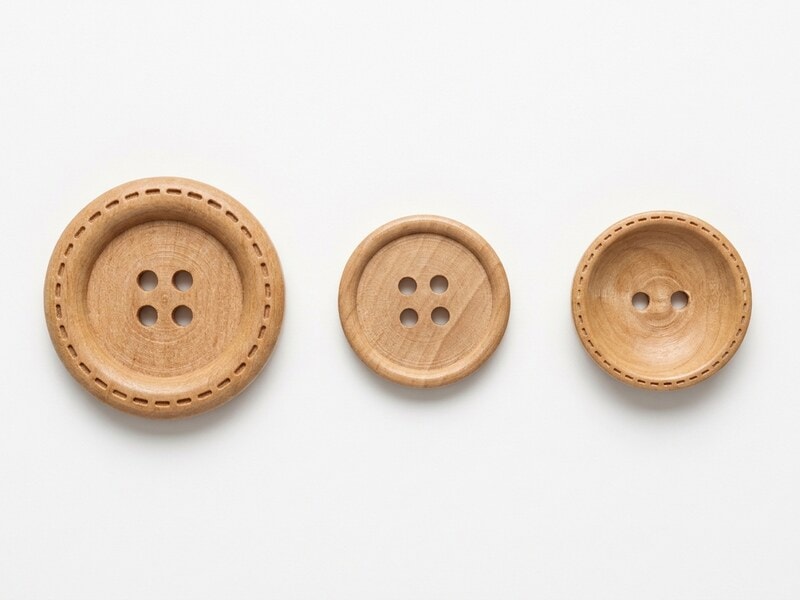
- Styles: 3 designs — wide-edge dashed 4 hole, thin-edge 4 hole, bowl shape dashed 2 hole
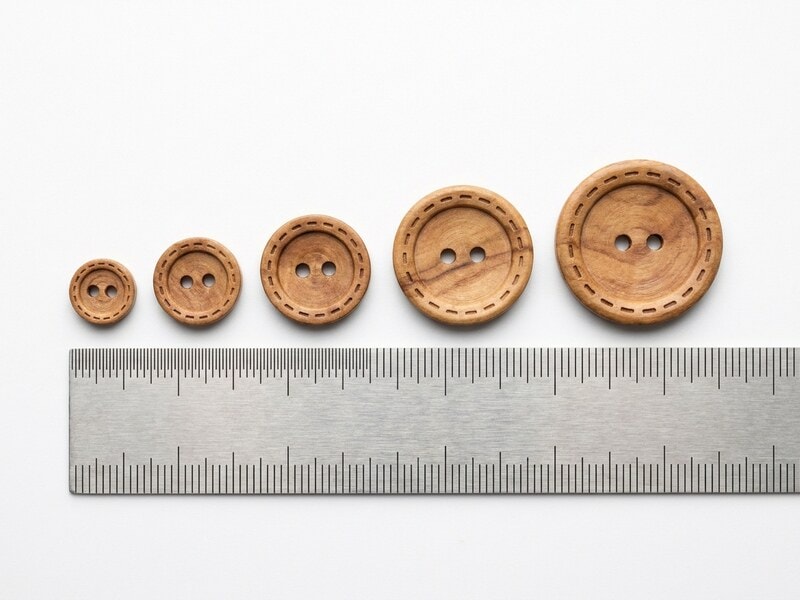
- Size: 5 sizes — 10mm, 13mm, 15mm, 20mm, 23mm
- Pack: 10 buttons per pack in 10mm to 15mm, 6 per pack in 20mm and 23mm
- Extra: A needle and thread are included
- Good for: Shirts, cardigans, sweaters, coats, dolls, bags and craft projects
What Are Natural Wood Buttons?
Natural wood buttons are sewing buttons cut from wood rather than molded from plastic or resin. The face is sanded smooth and cut with a shallow dashed groove around the rim, so the button looks stitched before you have even threaded a needle. The back is flat, with two or four holes through the center, which makes them ordinary sew-through buttons — any pattern written for a flat button will work. Weight is the other difference. A 23mm wood button is a fraction of what a metal button the same width weighs, so it will not drag the front edge of a fine cardigan out of shape.
What Are Natural Wood Buttons Made Of?
Wood, with a clear smooth finish that leaves the grain showing. No two buttons carry the same grain, so tone shifts slightly from piece to piece inside one pack — usually a shade or two, occasionally more. That variation is the reason most people choose wood over plastic, but it is worth knowing before you open the bag expecting six identical buttons. The dashed edge is carved into the rim rather than printed on it, so it does not rub off.
Why Are Natural Wood Buttons Worth It?
A pack of buttons costs a fraction of a new garment. On knitted pieces wood does more work than any other material: the warm tone reads as deliberate rather than mass produced, and a slightly wider button hides the loose, stretchy buttonhole you get on hand knits.
One piece of advice from experience — keep the spares. Buttons run in batches, and a wood button bought two years later will not match the five already on the cardigan. Leftovers in a tin are cheap insurance.
How Do You Choose the Right Natural Wood Buttons?
Style
The wide-edge dashed four hole design is the most decorative of the three, and it needs room — chunky knits and coats, where the carving is actually visible. The thin-edge four hole is the quiet all-rounder for shirts, blouses and fine cardigans. The bowl shape two hole has a slightly dished face that picks up the light, which suits children’s clothes, doll clothes and craft pieces.
Size
Measure the buttonhole, not the old button, and pick a button slightly narrower than the hole; our button size guide walks through the measuring step by step. Rough guide: 10mm and 13mm for doll clothes, baby garments and blouses, 15mm for shirts and fine cardigans, 20mm for standard cardigans, dresses and tote bags, 23mm for coats, jackets and chunky hand knits. Caught between two sizes on a knitted piece? Size down. Knitted buttonholes stretch with wear, and a button that fits snugly today will slip open by next winter.
Two Hole or Four Hole
Four holes hold more securely, so they are the safer pick for anything buttoned daily — a coat, a work shirt, a child’s jacket. Two holes stitch faster and leave a cleaner face, which suits decorative work and lighter garments. Both are flat backed, so neither needs the raised thread shank that a shank button calls for.
Quantity
Packs hold 10 buttons in 10mm to 15mm, and 6 in 20mm and 23mm. A standard cardigan takes five to seven down the front, so one pack of 20mm just about covers it with nothing left over. Coat with cuff buttons, or want spares in the tin? Order two packs.
How Do You Style Natural Wood Buttons?
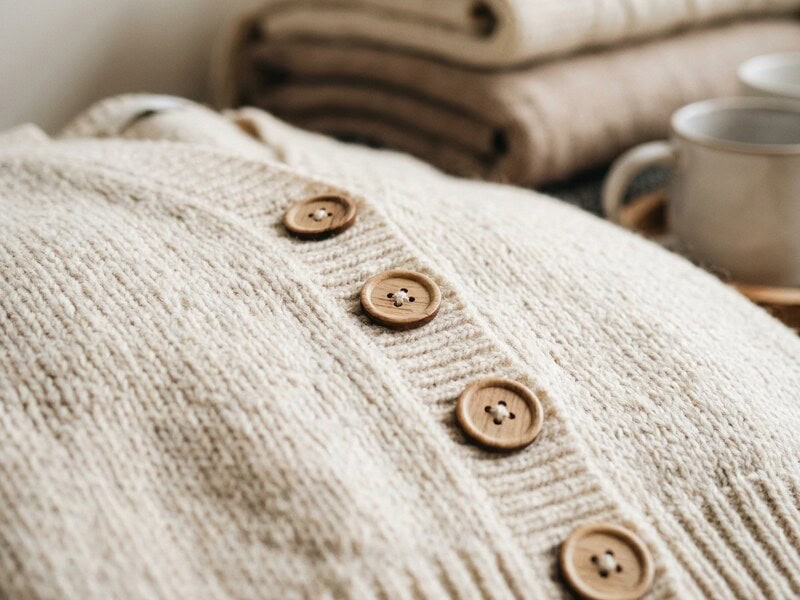
- Replace the flat plastic buttons on a shop-bought cardigan with 20mm natural wood buttons for an instant handcrafted look
- Use 23mm on a wool coat and match the thread to the wood rather than the fabric, so the stitching reads as part of the button
- Run 10mm buttons down a doll’s dress or a child’s pinafore where a larger button would overwhelm the piece
- Sew a row of mixed sizes along the flap of a canvas tote as pure decoration, with no buttonhole behind them, or swap in flower shaped wooden buttons for a softer outline
- Stitch spare buttons onto knitted garlands, gift tags and journal covers for craft projects
Buying for a shop or brand? These natural wood buttons are also available for wholesale and bulk orders, with trade pricing for boutiques, makers and studios. Tell us the sizes and quantities you need and we will send a wholesale button quote.
How Do You Sew On a Four-Hole Button?
- Mark the button position and thread a needle, doubling the thread and knotting the end.
- Bring the needle up through one hole from the back of the fabric.
- Pass it down through the diagonal or opposite hole, keeping a little tension so the button sits flat, then repeat across both pairs of holes to form parallel bars or a cross.
- Stitch through the holes several times to secure.
- Finish with a few small stitches on the back of the fabric and knot the thread.
For the two hole bowl shape design, work the same way using the single pair of holes. On a thick coat fabric, leave a little slack under the button and wrap the thread under it a few times before knotting, so the button has room to sit over the layers.
How Do You Care for Natural Wood Buttons?
Wood dislikes two things: long soaking and high heat. Hand wash where you can, or use a laundry bag on a cool gentle cycle, and keep bleach and strong solvents away from the buttons — both dull the surface. Wipe with a dry cloth rather than a damp one, press around the buttons instead of straight over them, and air dry rather than tumble dry. The iron is the one that catches people out: a hot plate straight onto a wood button will mark it. Stored dry between projects, the color holds for years.
Frequently Asked Questions
What are natural wood buttons made of? They are cut from wood and finished smooth, with a carved dashed groove around the edge and a flat back.
Are they two hole or four hole? Both. Two of the three designs are four hole sew-through and the bowl shape design is two hole. None of them are shank buttons.
What sizes do they come in? Five sizes: 10mm, 13mm, 15mm, 20mm and 23mm. 15mm suits shirts and fine knits, 20mm is the everyday cardigan size and 23mm suits coats.
How many buttons are in a pack? 10 buttons per pack in 10mm, 13mm and 15mm, and 6 per pack in 20mm and 23mm. A needle and thread are included.
Will the buttons all look the same? Close, but not identical. Wood grain varies from piece to piece, so tone and pattern differ slightly within a pack.
Can I wash garments with wood buttons on them? Yes, with care. Hand wash or use a gentle cool cycle in a laundry bag, and avoid soaking, bleach and tumble drying.
Can I order them in bulk? Yes. These buttons are available for wholesale and bulk orders with trade pricing, alongside smaller packs for home sewing.
Rule of Thumb
Four hole for anything buttoned every day, two hole for decoration, and 20mm if you only want to remember one size.
Where to Buy
Browse our natural wood buttons in three designs and five sizes from 10mm to 23mm, and pick the style and size that suits the project in front of you. Not sure which size fits your buttonholes? Send us a message using the contact details at the bottom of this page and we will help you work it out.
Can You Buy Natural Wood Buttons Wholesale?
Yes. As a button manufacturer, we offer these natural wood buttons for wholesale and bulk orders, with trade pricing for boutiques, fashion brands, tailors and craft studios. Whether you are stocking a shop, fitting out a production run or filling craft kits, we ship factory-direct internationally. Tell us the styles, sizes and quantities you need, using the contact details below, and we will reply with a wholesale quote and bulk availability.
Get in Touch
Have a question about our natural wood buttons, or want a wholesale quote? Contact our customer service team and we will be happy to help.
- Email: [email protected]
- Phone: +86 158-8823-7906
- Address: No. 163, Hanbu Road, Qiaoxia Town, Yongjia County, Wenzhou City, Zhejiang Province, China, 325106
Recommended Reading
- The Complete Guide to Buttons: Types, Materials and How to Choose
- Button Sizes Explained: How to Measure and Choose
- Sew-Through vs. Shank Buttons: Which One Should You Use?