
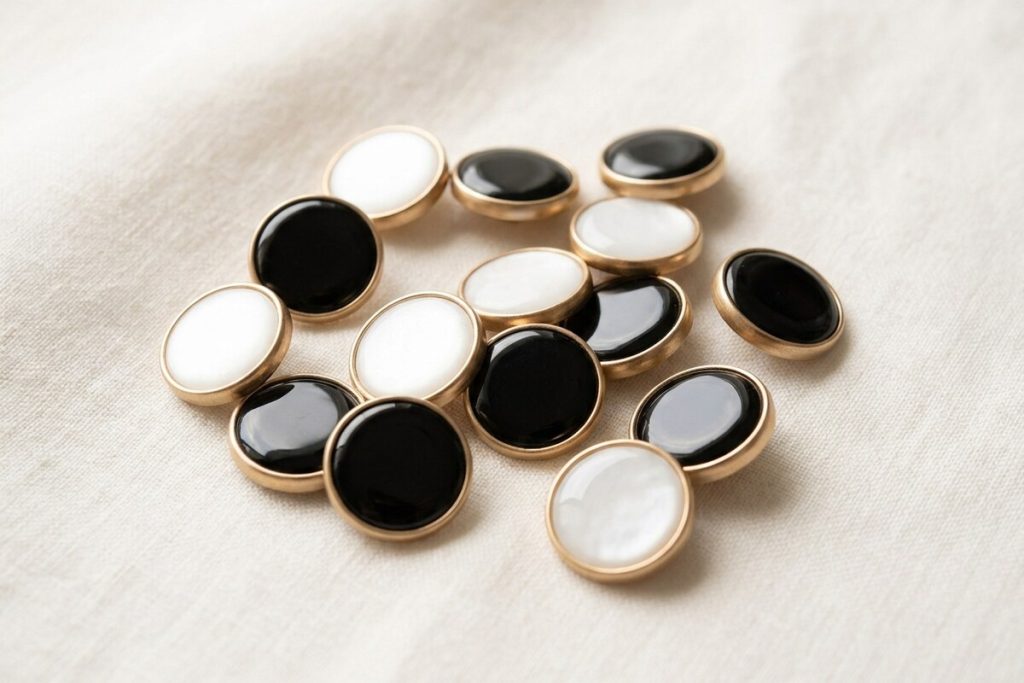
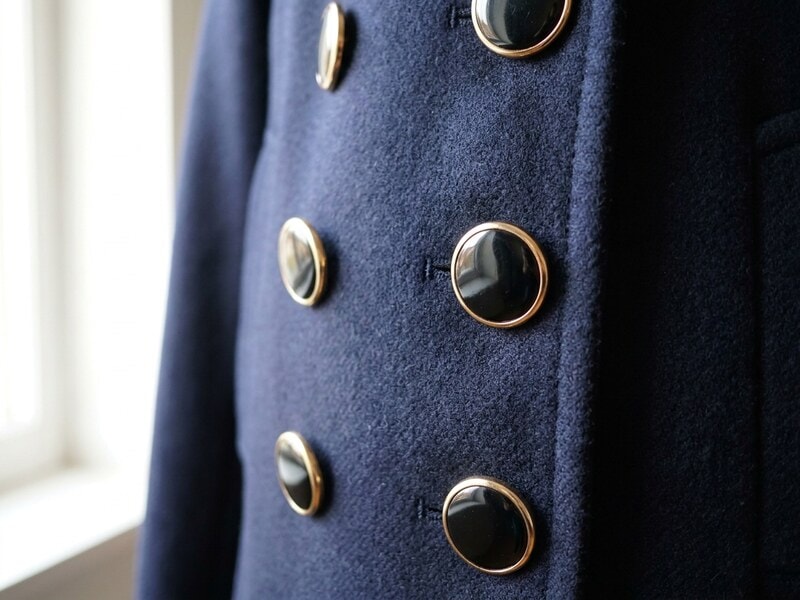
Quick answer: Enamel buttons are buttons whose face is filled with a smooth, glossy enamel or enamel-look coating, usually framed by a metal rim in a gold-tone or silver-tone finish. Ours come in two constructions: a metal base with an epoxy enamel face, and a resin base finished to read as enamel. Most have shank backs, and the range runs from 11mm to 25mm in black, white, cream and a spread of other colors.
The word enamel does a lot of work in the button trade, and not all of it honestly. It gets used for genuine vitreous enamel fired onto metal, for epoxy resin poured into a metal frame, and for plain plastic with a shiny coat sprayed on. The three look similar in a photograph and behave nothing alike on a garment. What follows is what enamel buttons actually are, which construction suits which project, how to read the rim, and how to wash a coat without dulling the face. If you are still comparing materials, our guide to the types of buttons sets the options side by side.
At a Glance
- Design: Round, square, heart, floral and motif faces, almost always set in a polished rim
- Material: Metal base with an epoxy enamel face, or resin with an enamel-look finish
- Back: Mostly shank loop; a few resin styles are sew-through
- Color: Black and white are the core shades, with assorted multi-color sets
- Size: 11mm to 25mm across the range
- Pack: 6 to 30 buttons depending on the style
- Good for: Coats, blazers, cardigans, knitwear, jackets, bags and craft projects
What Are Enamel Buttons?
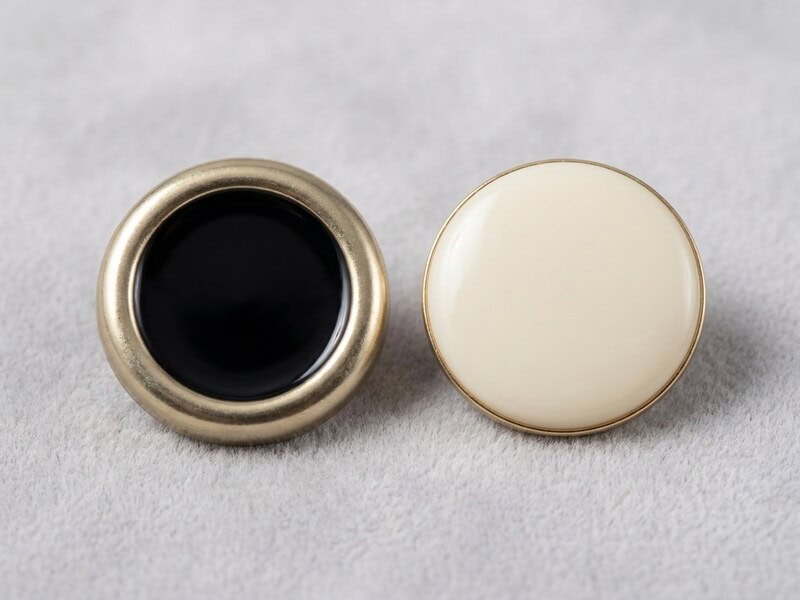
Enamel buttons are buttons with a filled, glass-smooth face rather than a molded or textured one. The defining feature is the contrast between two surfaces: a flat pool of color in the center and a raised metal edge around it, which is what gives the button its jewelry-like read. Take the rim away and most of the effect goes with it.
They sit in the same family as the rest of our decorative buttons, but enamel is the one that crosses over into tailoring. A black enamel button with a gold-tone rim is at home on a blazer in a way that a wooden or novelty button never is, which is why the style has outlasted most button trends.
What Are Enamel Buttons Made Of?
Two constructions, and it is worth knowing which one you are buying. The first is a metal base, usually alloy, with a recessed face filled with epoxy enamel and cured. This is the heavier, cooler-to-the-touch version, and the rim is part of the button rather than a separate trim. The second is a resin body finished with a glossy enamel-look surface, which sits in our wider range of resin buttons. Resin is lighter, cheaper to make in many colors, and better suited to lightweight knits where a metal button would drag.
The gold-tone and silver-tone rims are surface finishes over the metal, not solid precious metal. Enamel is also filled piece by piece rather than printed, so expect small differences between buttons: the fill level around the edge of the design varies slightly, and gloss can differ a touch from one to the next. On a placket of six, nobody notices. Under a lamp, side by side, you will.
Why Are Enamel Buttons Worth It?
Because they read as hardware rather than as fasteners. A row of black enamel buttons with gold-tone rims down a plain coat does what a new lining cannot: it changes the register of the whole garment for the cost of a coffee. That is the entire argument for decorative buttons, and enamel makes it more convincingly than any other material.
The second reason is that enamel is the least fussy of the decorative finishes. It does not scratch the way plated metal does, it does not yellow the way some plastics do, and a dry cloth brings the shine straight back. For a button that lives on a coat cuff and gets knocked against desks and door frames, that matters more than it sounds.
How Do You Choose the Right Enamel Buttons?
Style
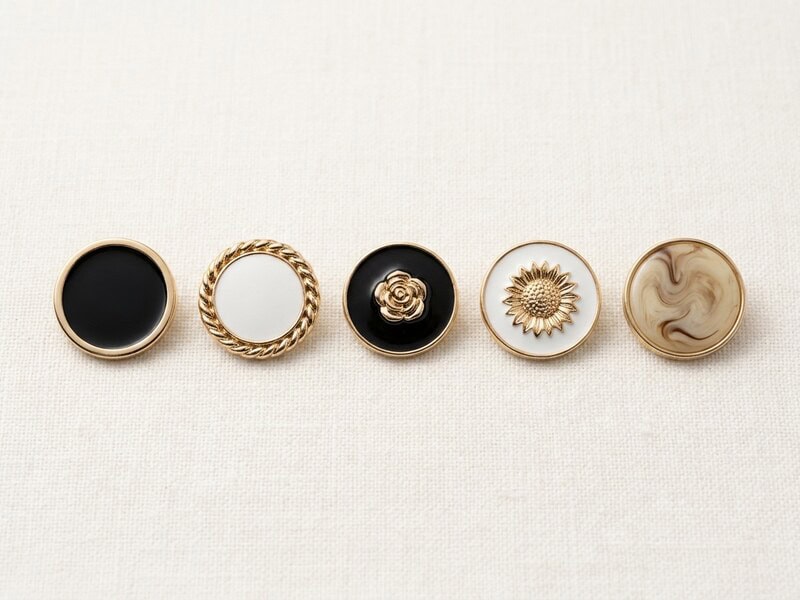
Start with how much you want the button to say. Plain round enamel with a narrow rim is the tailoring option and the safest place to start. Vintage enamel buttons add faceted rhinestone detail and come as an assorted set, which suits a garment where every button can differ. Chain edge buttons surround the enamel center with a braided metal rim, and read as the most formal of the lot on a blazer. Rose enamel metal buttons and sunflower buttons put a raised gold-tone motif on the enamel face for something more decorative. Bow enamel buttons set a raised bow-knot on the enamel face inside a rope-edged frame, in four combinations of white or black enamel with a gold-tone or silver-tone frame. Square rhinestone enamel buttons break the round format altogether, with a rounded square face and a diagonal row of rhinestones across it. Vintage marbled buttons take the enamel-look route in resin, with a swirled face instead of a flat one, and come in the widest color range. If you want a shaped enamel button rather than a round one, our guide to heart enamel buttons covers that style on its own.
Color
Black enamel with a gold-tone rim is the workhorse and the one to buy if you are only buying once. It sits correctly on camel, navy, cream, gray and tweed, and it is the combination that looks deliberate on tailoring. White and cream enamel is softer and reads as a quiet detail rather than a contrast, which is what you want on pale knitwear and on anything where a black button would look like a full stop. Assorted multi-color sets are a different proposition: they work when the buttons are the point, on a cardigan or a craft project, and they look scattered on a coat.
One thing to plan for: black enamel and gunmetal rims disappear into each other on a dark garment. If the garment is black, go gold-tone on the rim or the button vanishes.
Size
The range runs 11mm to 25mm depending on the style. 11 to 15mm suits shirts, blouses, cuffs and lightweight cardigans. 17 to 20mm is the everyday jacket and cardigan size and where most of our enamel styles sit. 23 to 25mm is coat territory, and on a metal-base enamel button that size carries real weight, so check the fabric can hold it without the buttonhole sagging. Measure the buttonhole rather than the old button, and allow a little extra clearance for a shank. Our button size guide covers how to measure properly.
Back and Attachment
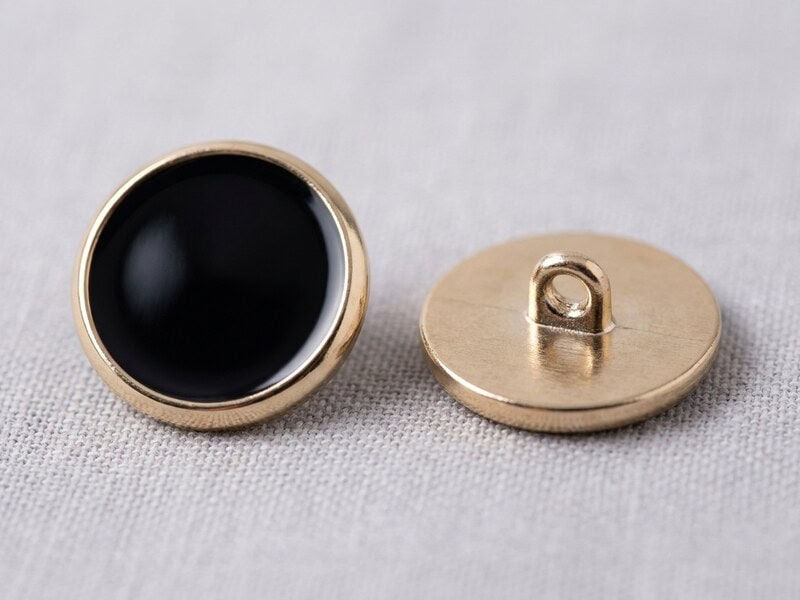
Most enamel buttons are shank buttons, and for good reason: the whole point is an unbroken face, and sew-through holes put thread across it. The loop sits under the fabric, the stitching stays hidden, and on a knit the shank lifts the button off the yarn so it does not sink in. A few of the resin enamel-look styles are four-hole sew-through instead, which is fine on a casual knit and wrong on a blazer. Check the listing before you order, or read shank vs sew-through first.
Quantity
Pack sizes are not standardized across the category, which catches people out. Our sunflower style comes 6 to a pack, the square rhinestone style comes 10, the bow style comes 12, and some motif styles run up to 30. Six covers a cardigan or jacket front with nothing spare. Ten to twelve covers a coat, or a garment plus cuffs with replacements left over. The larger packs are for craft kits and anyone making multiples. Buy spares either way. Enamel tone shifts slightly between production batches, and matching a single lost button a year later is never exact.
How Do You Style Enamel Buttons?
- Replace the buttons on a plain wool coat with 23mm black enamel and gold-tone rims, and match the thread to the fabric so the rim is the only bright thing on the front
- Keep the front buttons plain and put a decorative motif style on the cuffs only, which is how tailors get variety without making a garment look busy
- Use white or cream enamel on pale knitwear where you want texture rather than contrast
- Swapping the buttons on a boucle or tweed jacket is the single highest-impact change you can make to it, and enamel with a braided rim is the usual choice
- Alternate two rim finishes down one placket, gold-tone and silver-tone, for a subtle rhythm that only shows up close
- Sew spares onto hair clips, brooches and denim pockets for button craft projects, where the smaller sizes earn their keep
Buying for a shop or brand? These enamel buttons are also available for wholesale and bulk orders, with trade pricing for boutiques, makers and studios. Get in touch for a wholesale quote.
How Do You Sew On a Shank Button?
- Mark the button position and thread a needle, doubling the thread and knotting the end.
- Bring the needle up from the back of the fabric to the front at the mark.
- Pass the needle through the shank loop, then back down through the fabric close to where it came up.
- Repeat through the loop four or five times, keeping a little slack so the button sits comfortably.
- Wrap the thread a few times under the button to form a neat thread shank, then knot on the back of the fabric.
Ordinary all-purpose thread is enough. On a heavy coat, a doubled thread through a shank on a 25mm metal button will outlast the original factory stitching, which is usually the first thing to go. On a knit, take the stitches through a stable part of the stitch rather than a loose yarn float.
How Do You Care for Enamel Buttons?
Enamel is a surface, so treat it like one. A soft dry cloth brings the gloss back and is all most buttons ever need. Remove them before machine washing where you can, or turn the garment inside out and use a mesh laundry bag on a cool, gentle cycle. Keep bleach, solvents, nail polish remover and abrasive cleaners away, since all of them attack the rim finish long before they touch the enamel. Do not press a hot iron directly onto the face, and press around the buttons instead. Store spares in a small box rather than loose in a tin, where a harder metal button can chip the enamel edge.
Frequently Asked Questions
What are enamel buttons made of? Ours are either a metal base with an epoxy enamel face, or a resin base with an enamel-look finish. The gold-tone and silver-tone rims are surface finishes, not solid precious metal.
Are enamel buttons shank or sew-through? Most are shank, with a loop on the back so no thread crosses the face. A few resin styles are four-hole sew-through.
What sizes do they come in? From 11mm up to 25mm depending on the style, which covers shirt cuffs through to coats.
What colors are available? Black and white are the core shades, with cream and assorted multi-color sets across the range.
Will every button in a pack match? Closely, but not exactly. Enamel is filled piece by piece, so fill level and gloss vary slightly, and tone can shift between batches.
Can I put them in the washing machine? Better not to. Remove them if you can, or use a mesh bag on a cool gentle cycle and keep bleach away.
Can I order them in bulk? Yes. These buttons are available for wholesale and bulk orders with trade pricing, alongside smaller packs for home sewing.
Rule of Thumb
If you are buying once and want it to work, buy black enamel with a gold-tone rim at 18mm in a pack of 15. That single combination fits more garments than any other in the category, and the spares will find a home.
Where to Buy
Browse our enamel buttons in black, white, cream and assorted colors, in sizes from 11mm to 25mm, and pick the style and pack size that suit your project. You can also browse the full button range to see the enamel styles alongside everything else. Get in touch using the contact details at the bottom of this page and we will be happy to help.
Can You Buy Enamel Buttons Wholesale?
Yes. As a button manufacturer, we offer our enamel buttons for wholesale and bulk orders, with trade pricing for boutiques, fashion brands, tailors and craft studios. Whether you are stocking a shop, fitting out a production run or filling craft kits, we ship factory-direct internationally. Tell us the styles, colors, sizes and quantities you need, using the contact details below, and we will reply with a wholesale quote and bulk availability.
Get in Touch
Have a question about our enamel buttons, or want a wholesale quote? Contact our customer service team and we will be happy to help.
- Email: [email protected]
- Phone: +86 158-8823-7906
- Address: No. 163, Hanbu Road, Qiaoxia Town, Yongjia County, Wenzhou City, Zhejiang Province, China, 325106
Recommended Reading
- The Complete Guide to Buttons: Types, Materials and How to Choose
- The Complete Buying Guide to Vintage Heart Enamel Buttons with Gold Trim
- The Complete Buying Guide to Vintage Marbled Buttons